

A story
Remington and Russell
Frederic Remington painted the West from a short ranch stay and a long career of looking. Charles Russell cowboyed in Montana for eleven years and then painted what he had done. The pictures argue with each other.
A few months on a ranch, and then the magazines
Frederic Remington went to Kansas in 1883 and tried sheep ranching. It lasted a few months. The looking lasted the rest of his life. He drew and painted the action pictures Americans came to treat as the West: horses at a gallop, dust, a rescue, a last stand. Harper's and the other magazines made him a household illustrator. Collier's paid him, in the early 1900s, to deliver a Western subject on a regular schedule. He died on the day after Christmas, 1909, fifty-eight years old, with a late style that had turned toward night.
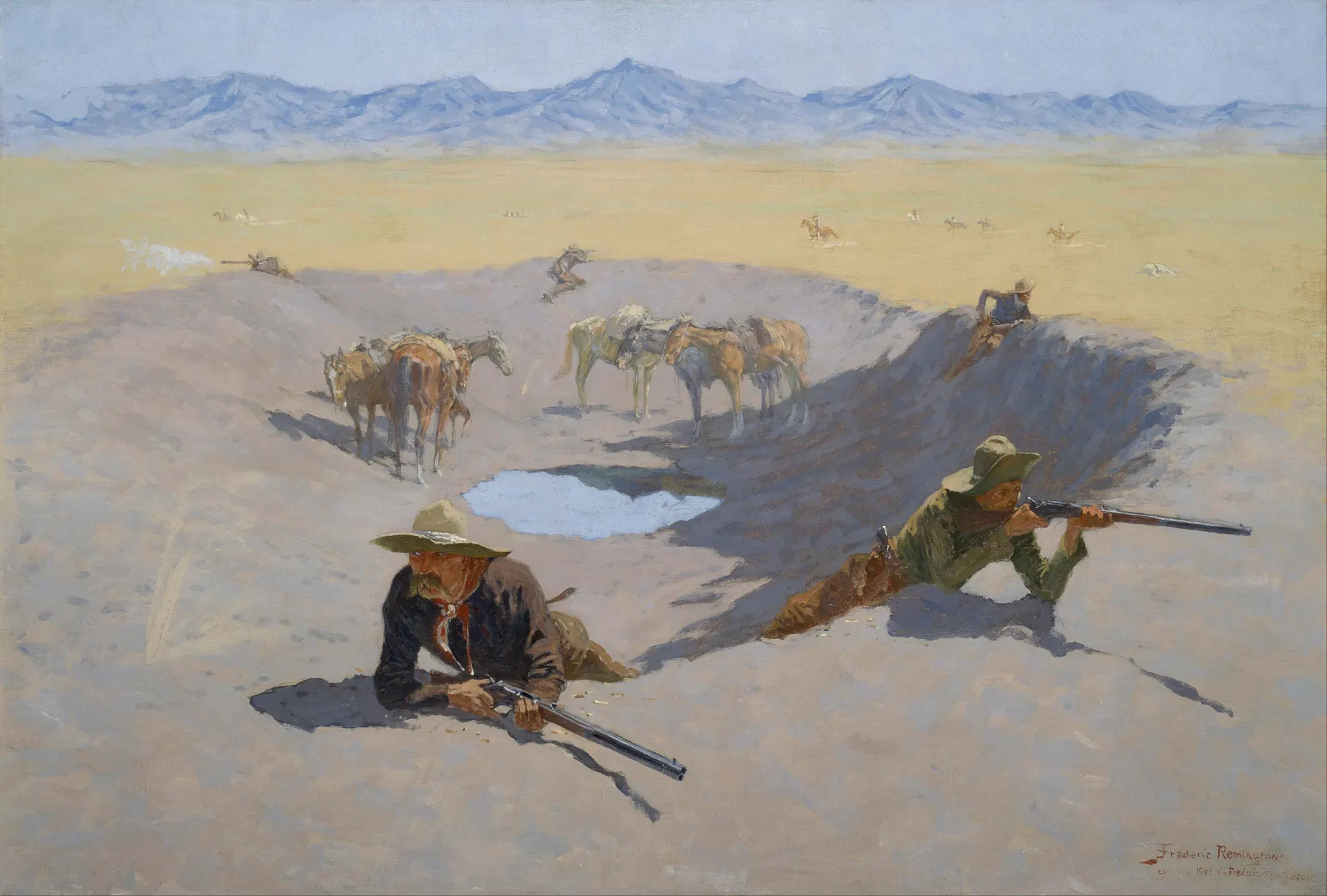
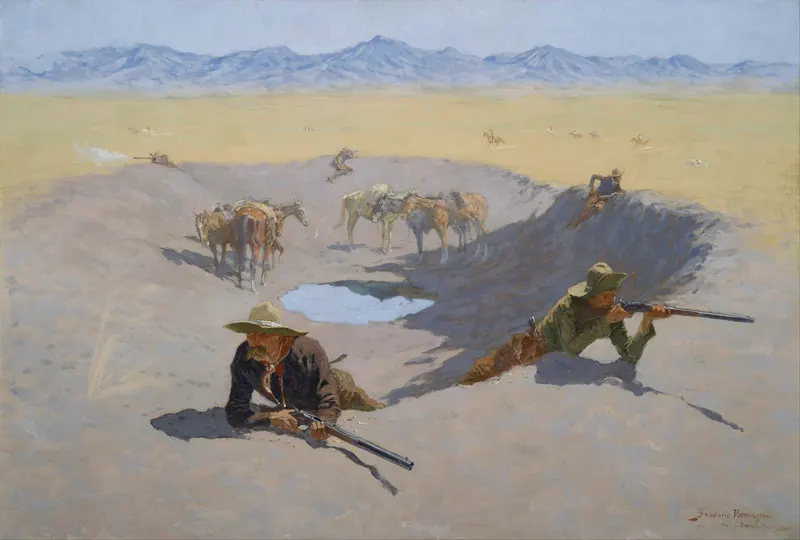
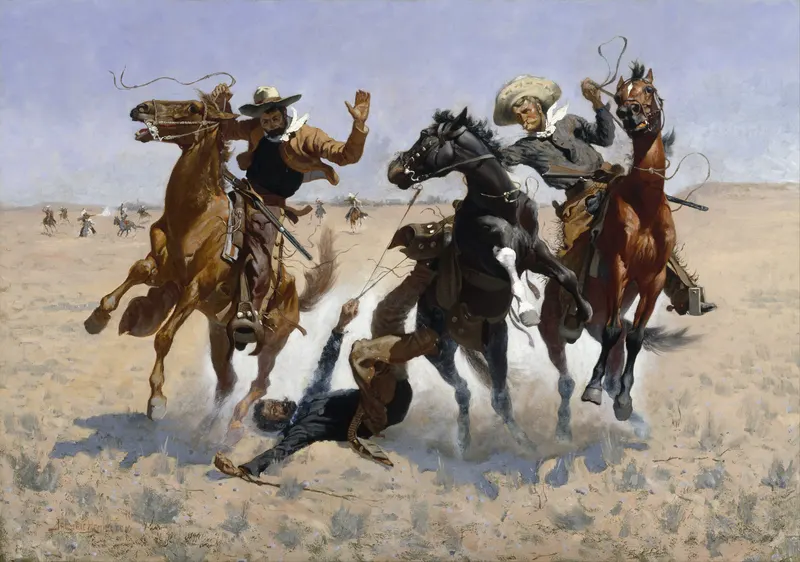
Aiding a Comrade, about 1890, is the gallop. Three riders race to a fallen man, the horses extended, the rescue already in motion. The Museum of Fine Arts, Houston, holds it. Fight for the Water Hole, 1903, also at Houston, was one of the Collier's pictures: five men at a shrinking desert water hole, other riders closing in, a palette the color of thirst. The sun is a character. So is the mud. It is the Remington people mean when they say he could make you feel a situation with the temperature of the paint.
The night pictures
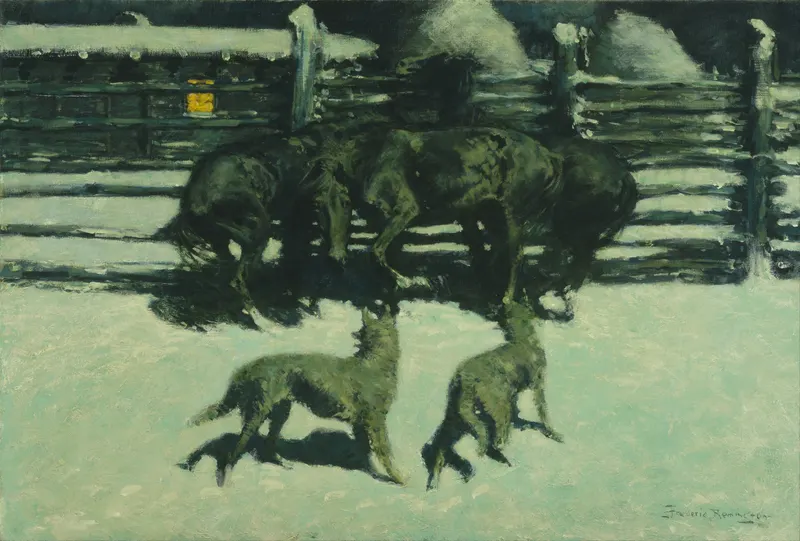
In the last years he taught himself a different light. The Call for Help, about 1908, is a nocturne, greens and blues, a figure and a horse in a darkness that has depth. Houston has this one too. It is quiet where the water-hole picture is desperate. He was interested, at the end, in how little you can show and still have a Western. A call going out into a night is a story with the gunfight left offstage. The painting trusts the silence.
Hang the three Remingtons as a life in brief. The 1890 gallop is the illustrator at full speed. The 1903 water hole is the magazine painter, sun and danger, a monthly deadline turned into a desert. The 1908 call is the nocturne, the hand slowing down, the West as a mood instead of a chase. He had earned the mood by drawing the chase for twenty years.
Eleven years on the Montana range
Charles Marion Russell left St. Louis for Montana in 1880 and spent about eleven years as a working cowboy before painting became the whole living. He knew the tack, the jokes, and the towns. He settled in Great Falls and kept painting Montana until he died in 1926. Where Remington often feels like a visitor with a superb eye, Russell feels like a man remembering his own crew. That difference is the reason to hang them in one room.
Smoke of a .45, 1908, at the Amon Carter Museum, is a saloon shooting, smoke and bodies and the chaos of a cow town on a bad night. In Without Knocking, 1909, also at the Amon Carter, is based on a real night in Stanford, Montana, in the 1880s, when cowboys rode their horses straight into a saloon. Russell knew men who had been there. The painting is the story told by someone who found it funny and exact, horses at the bar, the door no longer the point. The Buffalo Hunt No. 39, 1919, is one of many hunts he painted. By then the open-range herds he had known as a young man were gone. The hunt in the picture is a memory of a Plains life, riders and bison, made by a man who had watched that life narrow.
Six pictures, two painters, a useful argument. Remington's water hole against Russell's saloon: one imagined at a magazine's request, one remembered from towns he had ridden through. Remington's nocturne against Russell's buffalo. Both men were making the West for people who would mostly see it on a wall. Russell had more dirt under his nails. Remington had more control of a horse in midair. The museums are Houston and the Amon Carter. The dates run from about 1890 to 1919. The hang is the comparison.
Shop the story

No. 252 · Cowboys & Rodeo
Fight for the Water Hole, Frederic Remington, 1903
Painted by Frederic Remington
From $34
No. 250 · Cowboys & Rodeo
Aiding a Comrade, Frederic Remington, c.1890
Painted by Frederic Remington
From $34
No. 251 · Cowboys & Rodeo
The Call for Help, Frederic Remington, c.1908
Painted by Frederic Remington
From $34

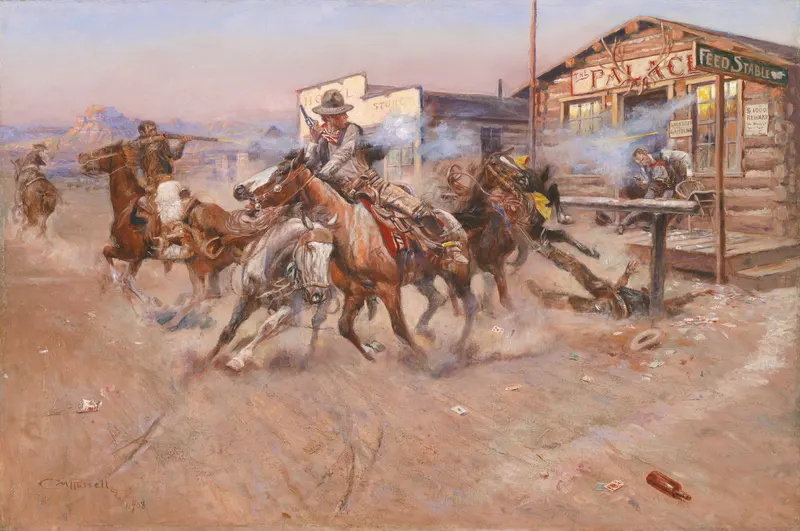
No. 253 · Cowboys & Rodeo
Smoke of a .45, Charles M. Russell, 1908
Painted by Charles M. Russell
From $34
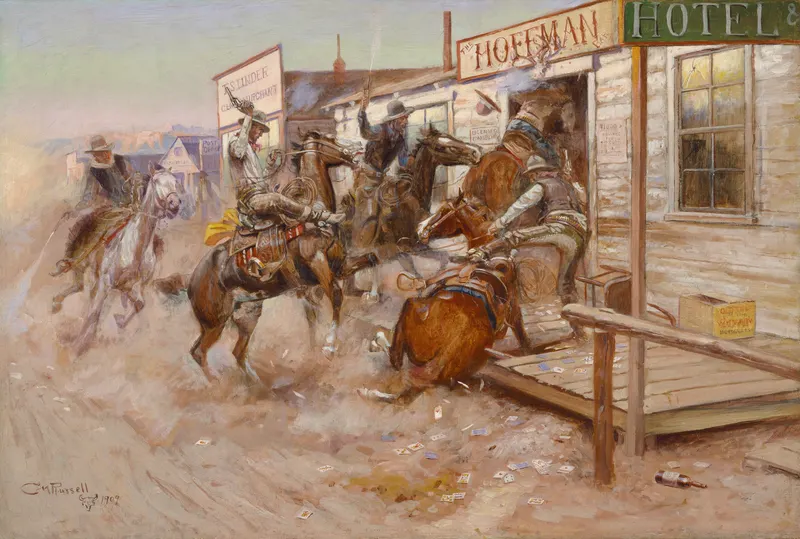
No. 254 · Cowboys & Rodeo
In Without Knocking, Charles M. Russell, 1909
Painted by Charles M. Russell
From $34
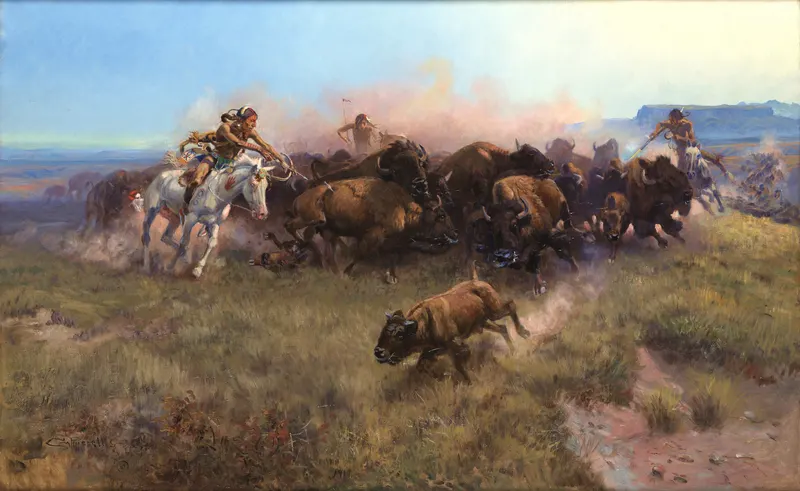
No. 255 · Native Nations
The Buffalo Hunt No. 39, Charles M. Russell, 1919
Painted by Charles M. Russell
From $34
Sources
- Frederic Remington, Fight for the Water Hole, 1903, Museum of Fine Arts, Houston
- Frederic Remington, Aiding a Comrade, about 1890, Museum of Fine Arts, Houston
- Frederic Remington, The Call for Help, about 1908, Museum of Fine Arts, Houston
- Charles M. Russell, Smoke of a .45, 1908, Amon Carter Museum
- Charles M. Russell, In Without Knocking, 1909, Amon Carter Museum
- Charles M. Russell, The Buffalo Hunt No. 39, 1919, Amon Carter Museum


