

A story
Bierstadt and Moran
Albert Bierstadt painted the Sierra in a studio in Rome and sent the canvas on tour. Thomas Moran came home from the 1871 Hayden survey and spent years on the Yellowstone. The shop has four of those pictures.
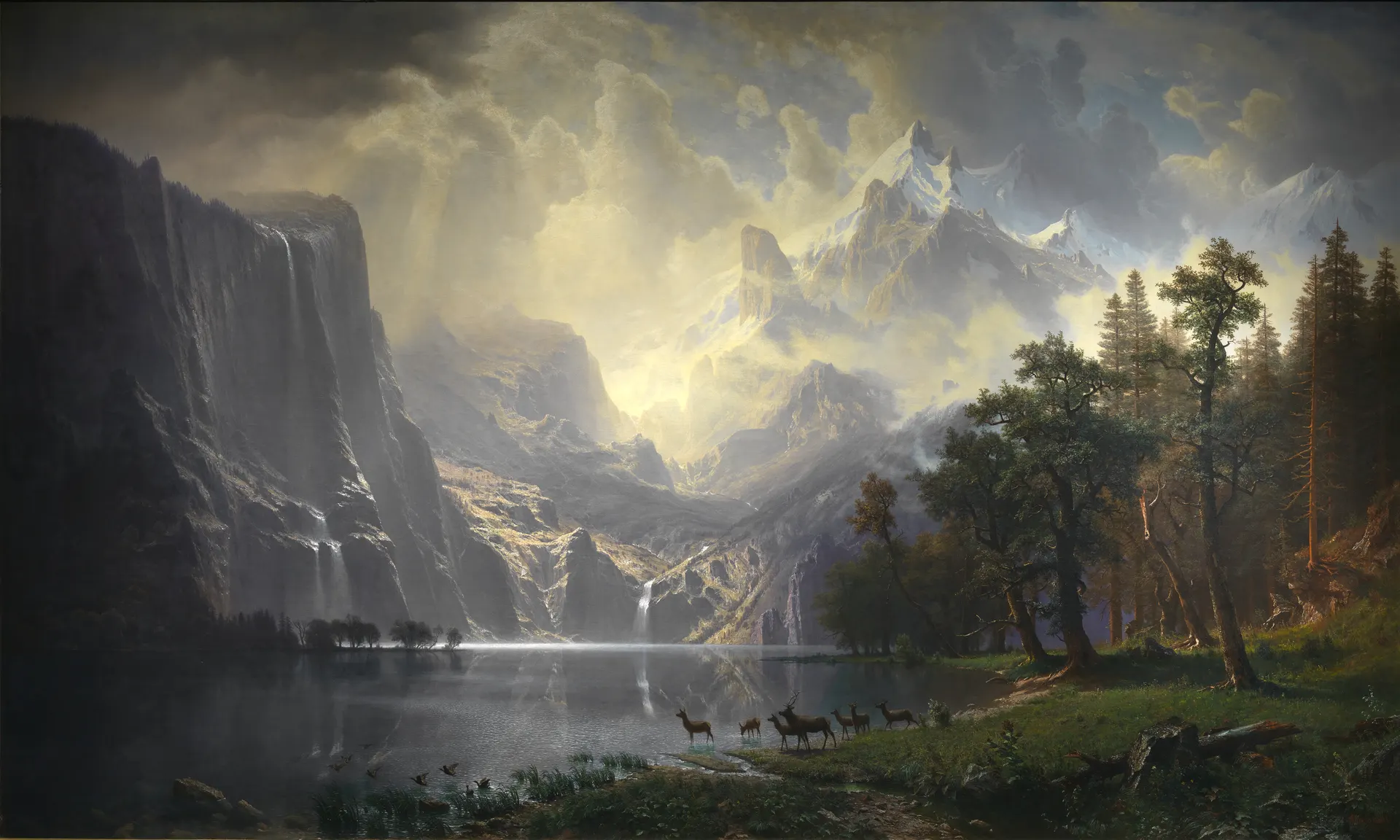
A studio light on a western lake
Albert Bierstadt went west to look, and then he went home to paint. The trip people remember first is 1859, with Frederick Lander's survey, sketchbox on his knee, the Rockies in front of him. The canvases came later, in studios, at a size meant for a public hall. Among the Sierra Nevada, California, the picture that opens this story, is dated 1868. He painted the six-foot canvas in Rome and toured it through Europe. The Smithsonian American Art Museum holds it now, in the open-access collection. The golden shore, the deer, the glass lake, and the peaks are a composed memory of California, arranged so a European room would feel the scale.
That arrangement is the point, and it is fair to say so. Bierstadt's light is warmer and cleaner than a given afternoon. He built a West that could recruit a settler and impress a patron at the same time. The painting sold because it was gorgeous, and it was gorgeous on purpose. Hanging it, you are hanging a nineteenth-century argument: this land is worth the journey, and here is the journey already finished, in a frame.
Mount Rosalie, and a price that made news
A Storm in the Rocky Mountains, Mt. Rosalie, dated 1866, is the thunderstorm version of the same ambition. Bierstadt named the peak for Rosalie Ludlow, the wife of his traveling companion. He later married her, after her divorce. The Brooklyn Museum has the painting. The sale was reported at $25,000, a price that made news in the 1860s, when a large American landscape could still astonish a buyer who had mostly seen smaller work. The shop's record of the picture carries that figure. The canvas carries the storm: a dark pile of cloud, a lit valley, small figures and animals there to give the cliffs their size.
Rocky Mountain Landscape, 1870, is the quieter sibling, and it hangs in the White House collection. A lake, a break in the clouds, peaks behind. It is the Bierstadt idea reduced to a single breath of light. Three Bierstadts in one room will teach you his method faster than a caption. Rome studio, Brooklyn storm, White House lake. Same painter, same belief that the West could be told in gold and weather.
Moran, the survey, and a signature
Thomas Moran came at the same mountains from a different errand. In 1871 he traveled with Ferdinand Hayden's geological survey into the Yellowstone country, drawing while William Henry Jackson photographed. The watercolors and the photographs went to Washington. In 1872 Congress created Yellowstone National Park, the first national park. Moran's pictures were part of what the lawmakers had in front of them. He liked the connection enough to sign work TYM, Thomas Yellowstone Moran.
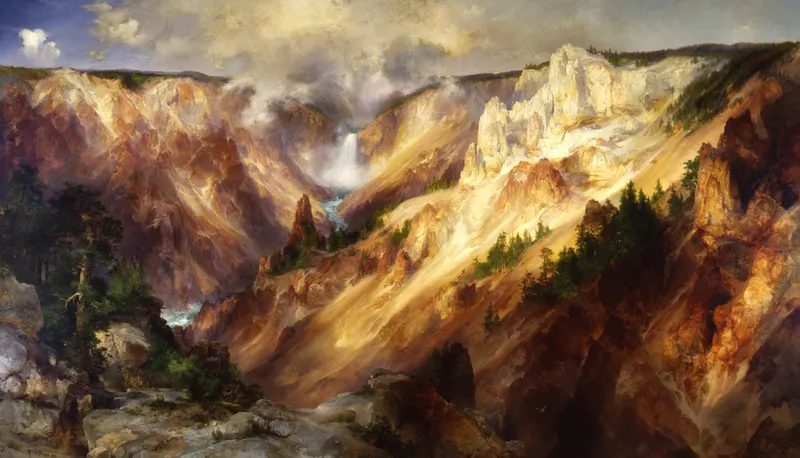
The Grand Canyon of the Yellowstone in the shop is the Smithsonian American Art Museum canvas he worked on between 1893 and 1901, a return to the view rather than a field sketch. The falls drop in the middle. The canyon walls are the mineral colors he had learned on the survey, cream and rust and a yellow that earns the park's name. He had been repainting this subject for years. The late canvas is the experienced one: a place he had helped make famous, seen again with a slower hand.
Bierstadt and Moran are easy to confuse at a distance and easy to separate up close. Bierstadt gives you a pastoral glow and a lake you could walk into. Moran gives you geology, a cut in the earth, water doing damage beautifully. Hang the Sierra opposite the Yellowstone and the room holds both ideas of the West that eastern audiences bought: a promised garden, and a canyon that changed the map. The museums are on the sources. The dates are on the canvases. The light is theirs.
Shop the story

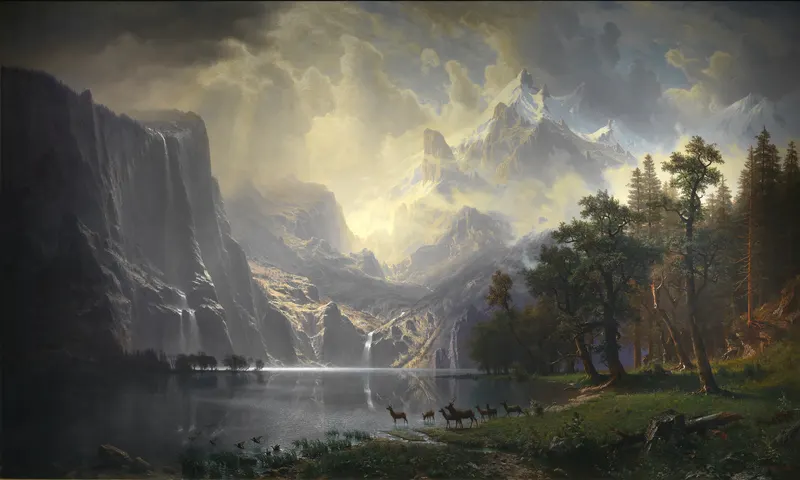
No. 257 · Frontier & Desert Landscapes
Among the Sierra Nevada, California, Albert Bierstadt, 1868
Painted by Albert Bierstadt
From $34
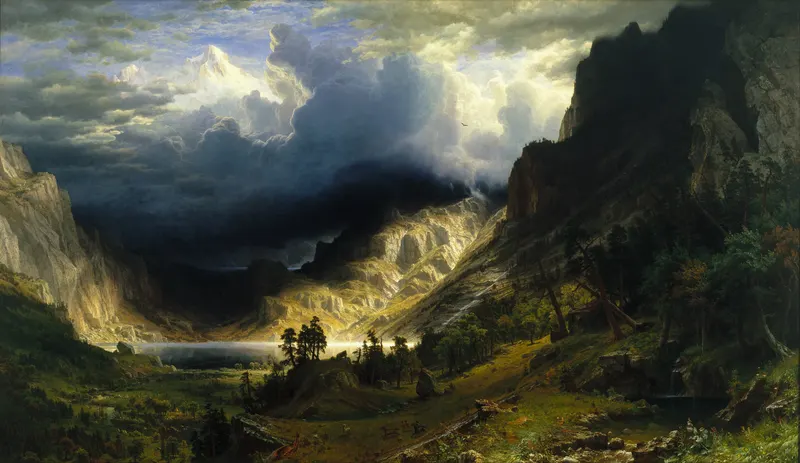
No. 258 · Frontier & Desert Landscapes
A Storm in the Rocky Mountains, Mt. Rosalie, Albert Bierstadt, 1866
Painted by Albert Bierstadt
From $34
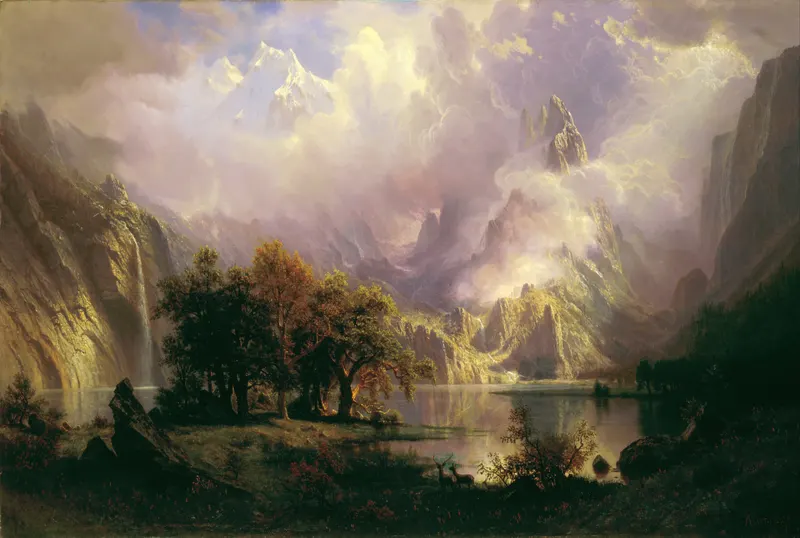
No. 259 · Frontier & Desert Landscapes
Rocky Mountain Landscape, Albert Bierstadt, 1870
Painted by Albert Bierstadt
From $34
No. 260 · Frontier & Desert Landscapes
Grand Canyon of the Yellowstone, Thomas Moran, 1893-1901
Painted by Thomas Moran
From $149
Sources
- Albert Bierstadt, Among the Sierra Nevada, California, 1868, Smithsonian American Art Museum 1977.107.1
- Albert Bierstadt, A Storm in the Rocky Mountains, Mt. Rosalie, 1866, Brooklyn Museum
- Albert Bierstadt, Rocky Mountain Landscape, 1870, White House collection
- Thomas Moran, Grand Canyon of the Yellowstone, 1893–1901, Smithsonian American Art Museum


