

A story
Gottscho's Miami Beach
Morris Lapidus opened the Fontainebleau in December 1954. Gottscho-Schleisner photographed the new hotel in March 1955. Two of those pictures are in the shop, plus an older Miami hotel from a different camera.
A hotel in its first spring
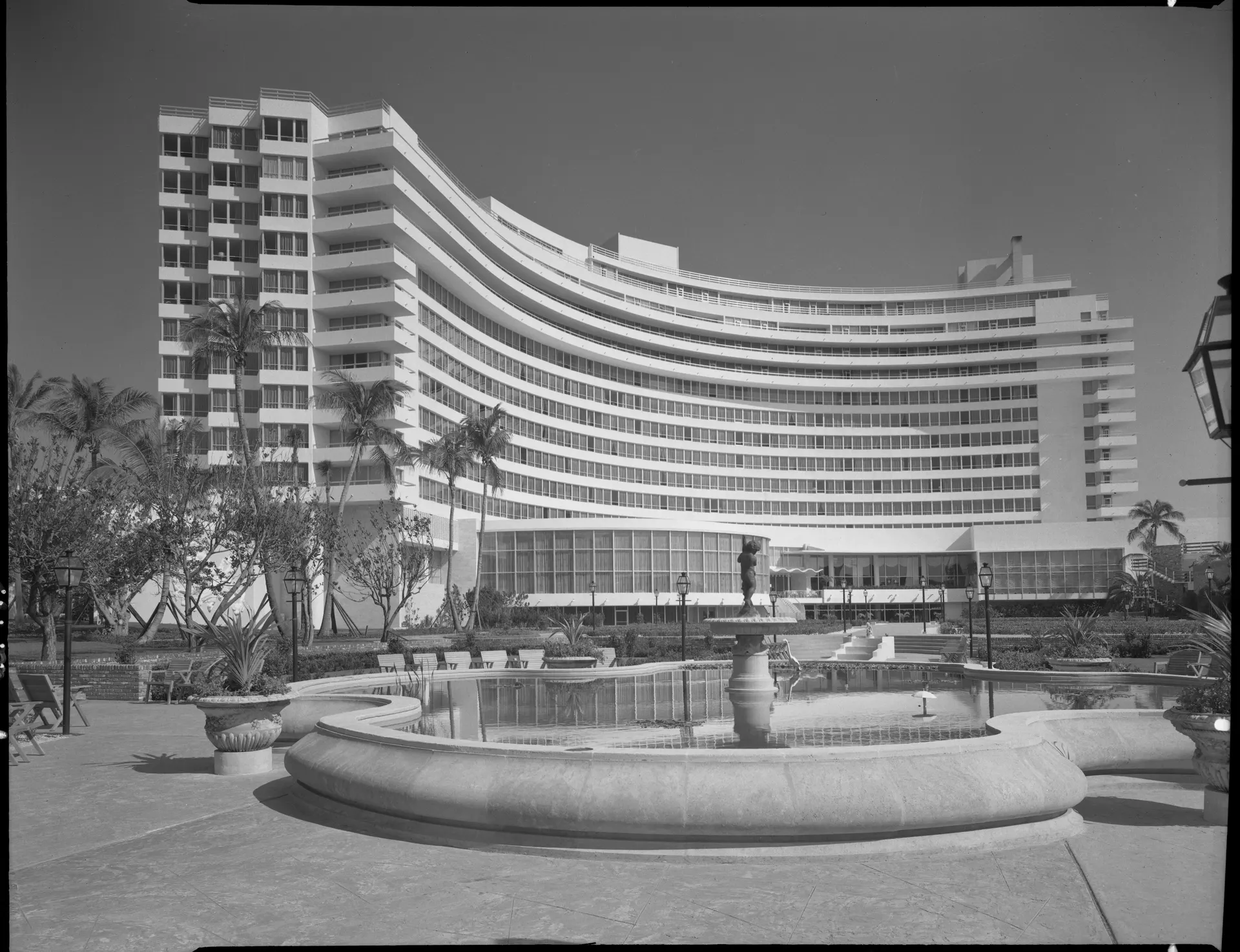
The Fontainebleau opened on Miami Beach in December 1954. Morris Lapidus designed it: a long curve of rooms, a lobby meant to feel like a ship, a pool set so the building could show off. Architectural opinion argued about that curve. Guests filled the rooms. By March 1955 the hotel was still new, and the New York architectural photographers Samuel Gottscho and William Schleisner came down and made a record of it.
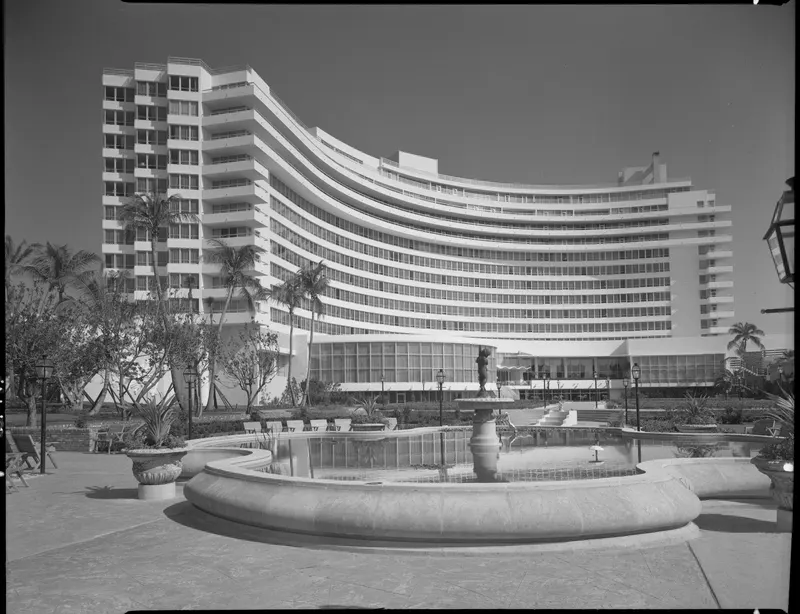
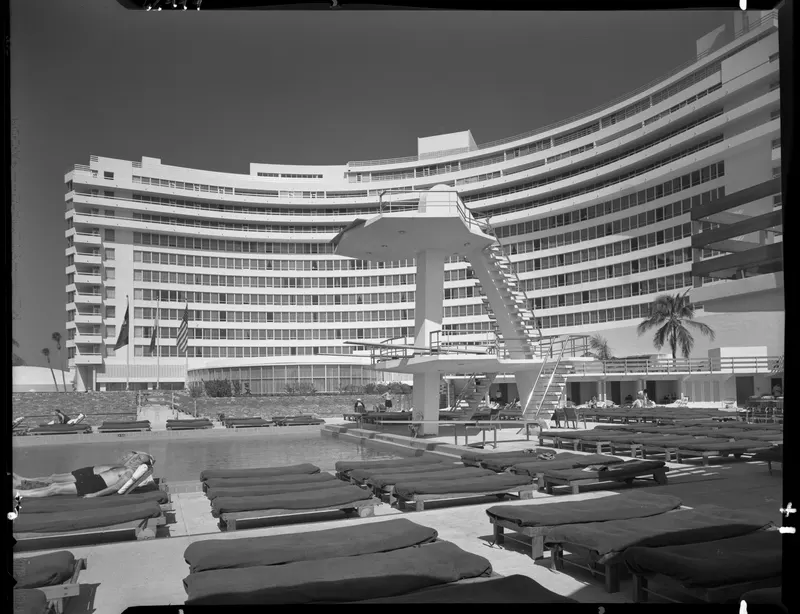
Two frames from that job are in the Gottscho-Schleisner Collection at the Library of Congress, both marked no known restrictions on publication. One looks along the pool, item 2018727406. The other stands off on the grounds and takes in the tower and the curve, item 2018727407. Together they are the building before it had a legend attached. The famous nights came later. These photographs are the first spring.
What the pool picture is doing
Lapidus liked a view that unfolded. The pool photograph understands that. The water is a foreground, the curve of the hotel is the subject, and the eye travels the way a guest's eye would, from the near deck toward the stacked balconies. Gottscho had spent decades photographing American buildings for architects and for magazines. He knew how to stand where the drawing wanted a person to stand. March light on Miami Beach is high and a little hard. The concrete reads as clean. The pool reads as a mirror with a job.
The second frame steps back. From the grounds the tower is the event, a vertical accent on a building that is otherwise a horizontal sweep. Hung beside the pool picture, it explains the hotel the way a plan and an elevation explain a house. One is the experience. One is the object. Both are dated, in the Library's files, to that March.
Gottscho and Schleisner were a firm, and the collection carries both names. Their negatives and prints of houses, stores, and hotels went to the Library of Congress. Miami Beach was a small slice of a much larger archive of American buildings. That is a good reason the pictures feel precise. They were made as documents of a design, by people who did that for a living, in the season the design was finished. A researcher still finds them by the hotel's name and the month, which is the gift of a studio that filed its work as carefully as it lit it.
A different hotel, fifty years earlier
The third picture in this group is not a Gottscho. It would be a cheat to pretend it was. It is a Detroit Publishing Company photochrom of Henry Flagler's Royal Palm Hotel, made in 1901, Library of Congress control number in the file name as LCCN 2008679529. Flagler opened the Royal Palm in 1897 at the mouth of the Miami River, the year after Miami was incorporated. The print is the older city: a wooden resort, a river mouth, a bay, and the color process Detroit licensed from Switzerland.
Put it near the Fontainebleau pictures and the beach has a before. In 1901 the grand hotel was Flagler's, on the river, built to give his railroad a reason to arrive. In 1955 the grand hotel was Lapidus's, on the ocean, built to give a new kind of vacation a shape. The cameras are different, the processes are different, and the captions should stay honest about that. One pair is Gottscho-Schleisner, March 1955, items 2018727406 and 2018727407. One is Detroit Publishing, 1901, the Royal Palm. The story is the same coast learning, twice, how to build a hotel worth a picture.
Shop the story
No. 215 · Leisure & Resort
Fontainebleau, Over the Pool, 1955 (Gottscho-Schleisner)
Photographed by Gottscho-Schleisner
From $29
No. 216 · Leisure & Resort
Fontainebleau, Miami Beach, 1955 (Gottscho-Schleisner)
Photographed by Gottscho-Schleisner
From $29

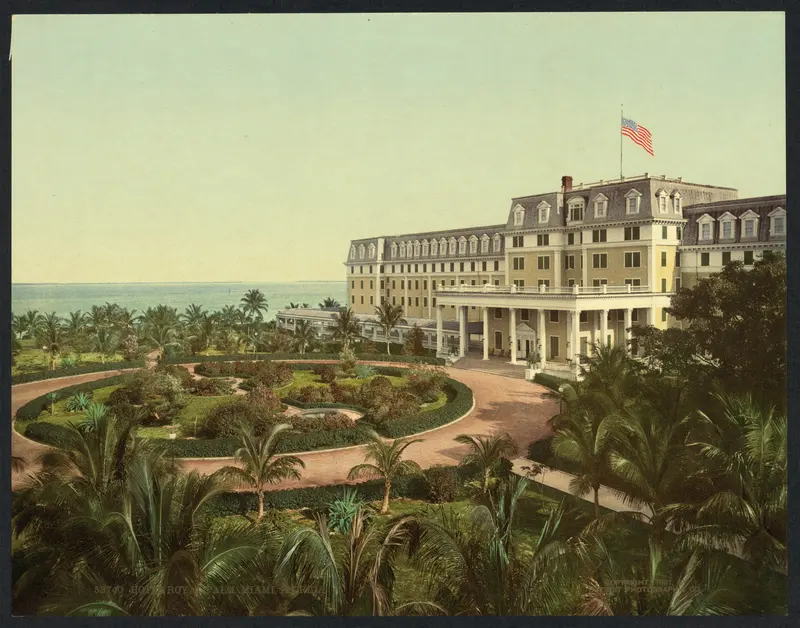
No. 059 · Your City
Miami, 1901: The Royal Palm
Photographed by Detroit Publishing Company
From $29