A story
A canyon train, and the day the rails met
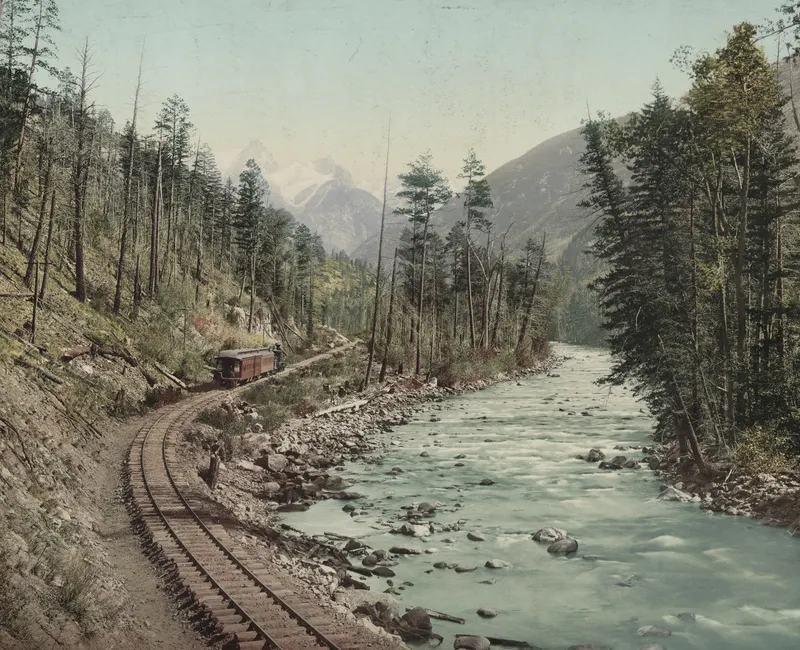
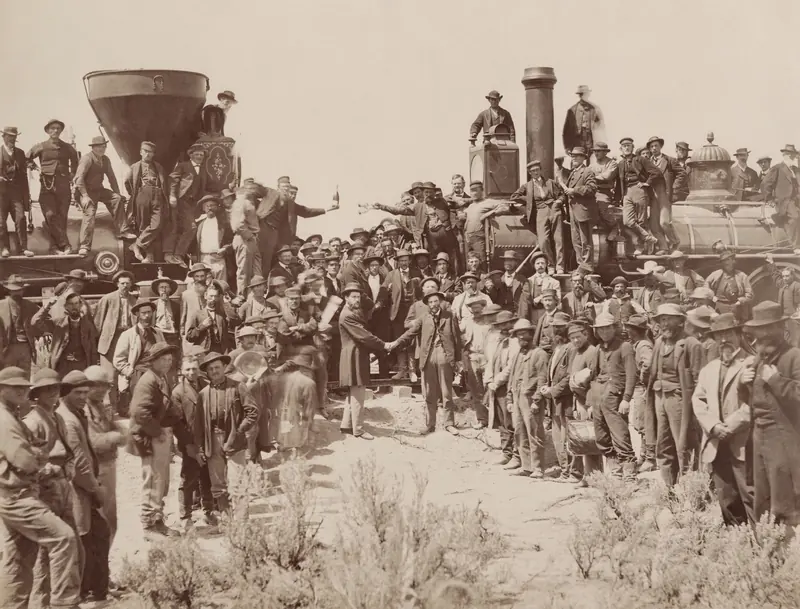
William Henry Jackson's 1899 photochrom shows a train in the Canyon of the Rio Las Animas, rapids below and the San Juan Mountains behind. Thirty years earlier, Andrew J. Russell photographed the locomotives touching at Promontory Summit.
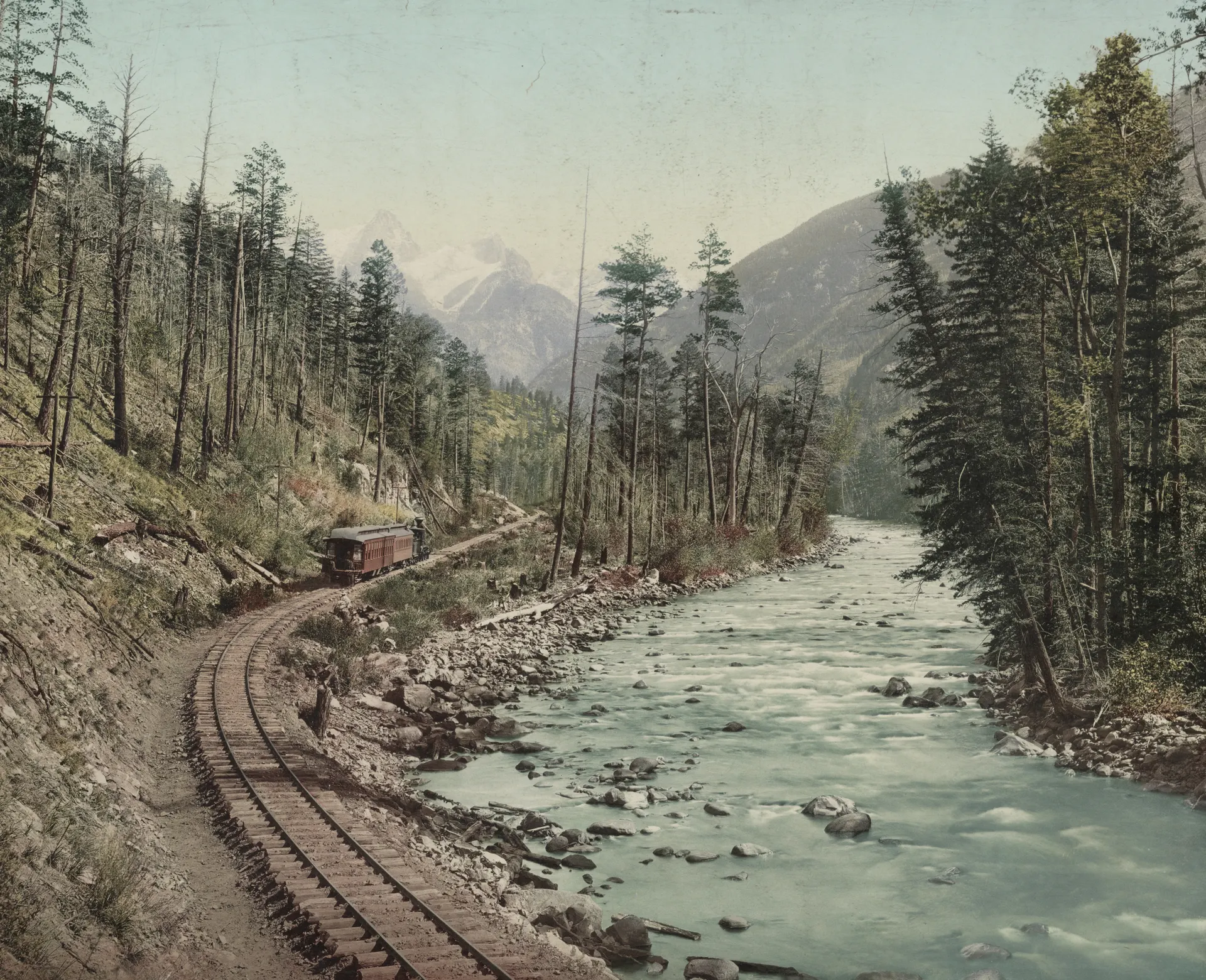
The 1899 photochrom
Library of Congress item 2016802684 is titled Colorado, Canon of the Rio las Animas. The date is about 1899. The medium is one photochrom, in color, 43.4 by 53.4 centimeters. The Library files the subject as a mammoth plate. The notes say the view includes rapids, railroad tracks with a train, and the San Juan Mountains in the background. Detroit Publishing Co. number 59013. William Henry Jackson is named as a contributor, with the Detroit Publishing Co. The contributor line dates Jackson from 1843 to 1942 and lists Detroit as the copyright claimant as well as the publisher. The call number is LOT 3888, number 37. The note on provenance reads copyright deposit, State Historical Society of Colorado, 1949. The rights line is no known restrictions on publication. A second title on the print, the Library says, begins "1039, Canon of." The reproduction number on the record is LC-USZ62-134841, a black-and-white film copy negative of a print that was made in color.
The account kept with this print names the railroad. It says the Denver & Rio Grande built the 45-mile line from Durango to Silverton in 1881 and 1882, in a little more than nine months, to haul ore from the San Juan mines, and that the first train reached Silverton in July 1882. The rails are three feet apart. The line climbs more than 2,500 feet. Up the canyon the track sits on a rock ledge just wide enough for the train. After the Second World War the business turned to passengers, and the same rails still run as the Durango & Silverton Narrow Gauge Railroad, a National Historic Landmark in 1961 and a National Historic Civil Engineering Landmark. The color is Detroit's photochrom: a black-and-white negative printed through a separate lithographic stone for each color. Jackson made the photograph. Detroit made the ink.
May 10, 1869
The earlier picture is the meeting the mountain lines descended from. Golden Spike National Historical Park says the best-known photograph of the first transcontinental railroad is Andrew J. Russell's "East and West Shaking Hands at Laying of Last Rail," often called the champagne photo. It is one of many glass plates made on May 10, 1869, by three photographers at the ceremony. After the last spike was driven, Union Pacific engine No. 119 and the Central Pacific's Jupiter were brought up until they nearly touched. Samuel S. Montague, the Central Pacific's chief engineer, and Grenville M. Dodge shook hands between them. Engineers George Booth and Sam Bradford broke bottles of champagne on each other's locomotives. The park says about a thousand people were there, among them a Chinese contingent from the Central Pacific and five companies of the 21st Infantry.
Russell had been a Union officer and photographer for the U.S. Military Railroad Construction Corps, then went west to record the Union Pacific as it built out from Omaha. The park describes the work of one plate: compose on ground glass, sensitize the glass, keep it wet, pull the lens cap by guess, and develop in a portable darkroom. His 10 by 13 inch negatives, about 650 of them, are at the Oakland Museum of California. The print in the shop is that Promontory picture, May 10, 1869. The Animas photochrom is the same idea thirty years later and a thousand miles farther into the mountains: a train on a ledge above a river, with the San Juan Mountains behind it, printed in color by the Detroit Publishing Co. in about 1899.