A story
Philip Reid and the Statue of Freedom
The bronze woman on the Capitol dome was sculpted by Thomas Crawford and cast in Clark Mills's foundry. Philip Reid, an enslaved artisan in that foundry, figured out how to take the plaster model apart. He was a free man when the last section went up on December 2, 1863.
A helmet, not a liberty cap
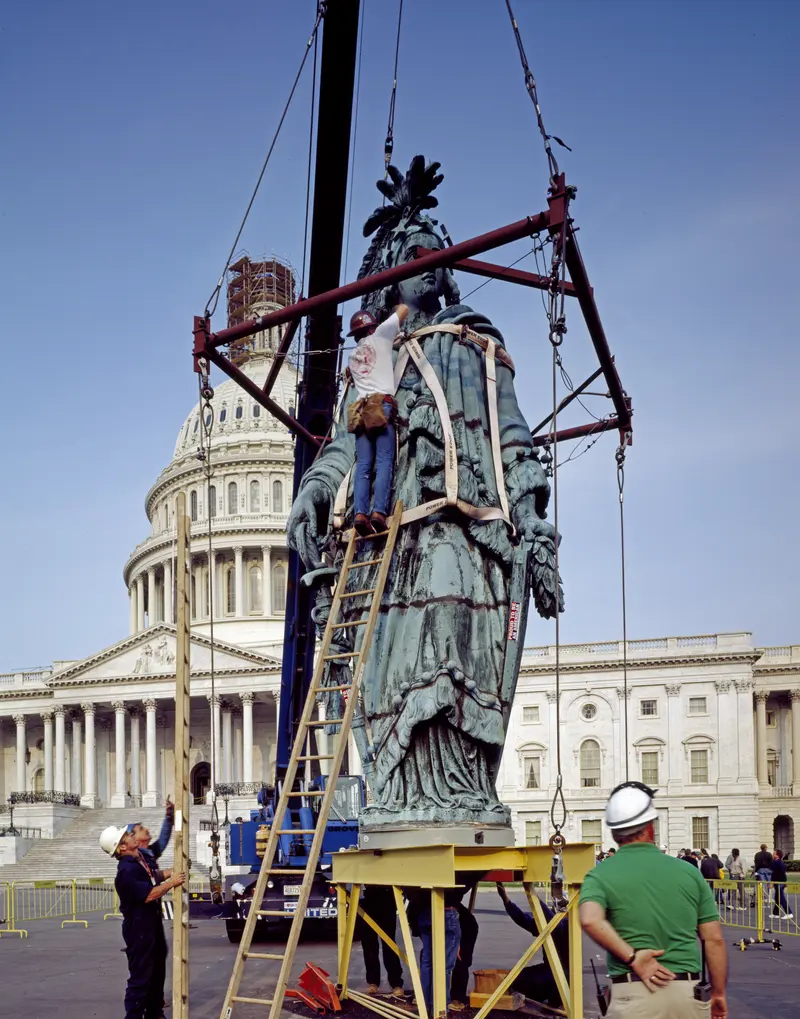
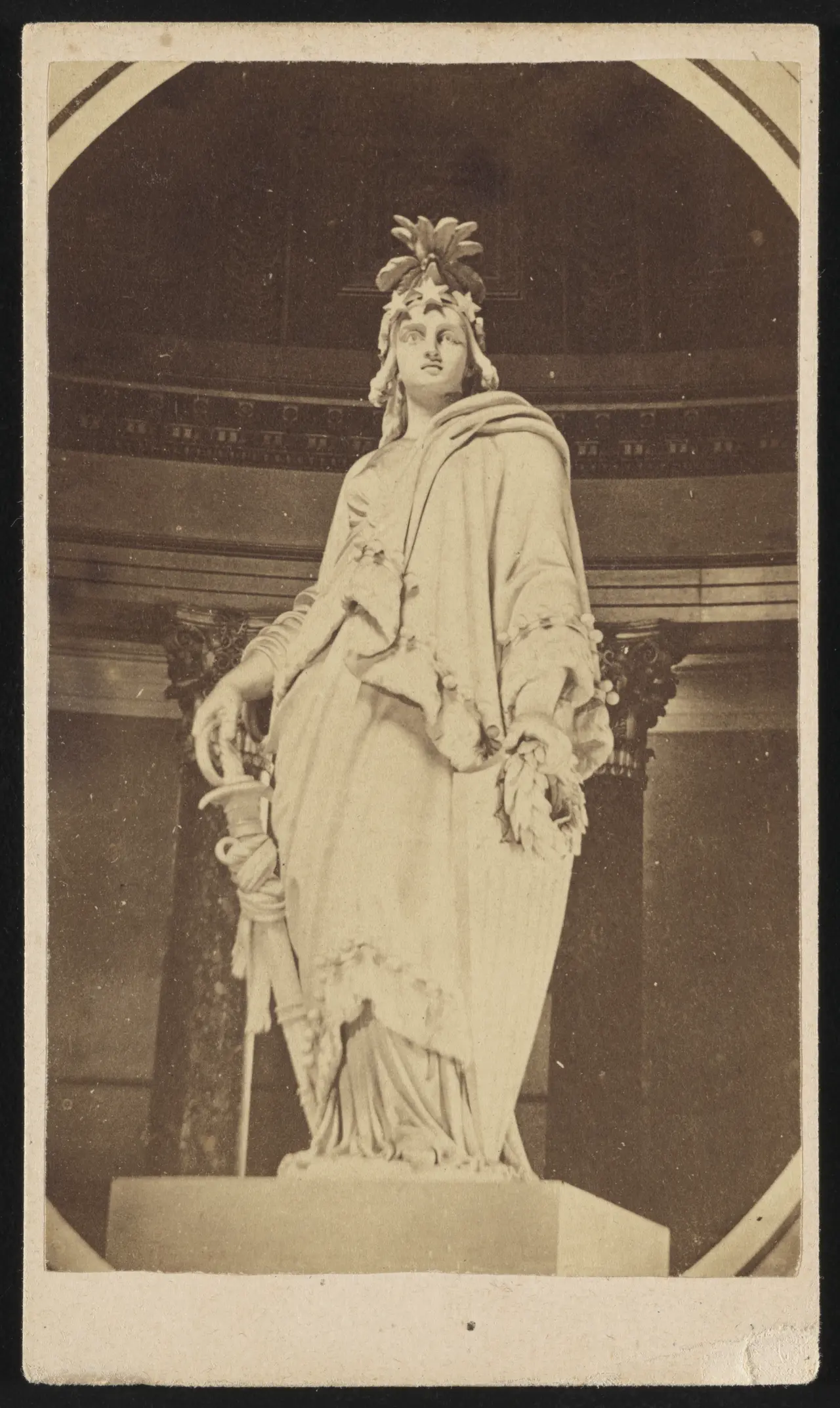
The Architect of the Capitol describes the Statue of Freedom as a classical female figure, 19 feet 6 inches tall, in bronze, dated 1863, standing on the Capitol dome. She has long hair and a helmet whose crest is an eagle's head and feathers. A brooch on her dress is inscribed "U.S." Her right hand rests on the hilt of a sheathed sword. Her left hand holds a laurel wreath and the shield of the United States with 13 stripes. Nine stars circle the helmet. Ten bronze points tipped with platinum are fixed to the headdress, shoulders, and shield as lightning protection. She stands on a cast-iron pedestal topped with a globe and the motto E Pluribus Unum. The pedestal is 18 1/2 feet high. The crest of the headdress rises 288 feet above the East Front Plaza.
She does not wear a liberty cap. The Architect of the Capitol explains that the knit cap given to freed slaves in ancient Rome had become a symbol of liberty in the American and French Revolutions, usually shown as red, and that Freedom's helmet and sword are closer to Minerva or Bellona. A statue for the new cast-iron dome was part of Architect Thomas U. Walter's design, authorized by Congress in 1855. Walter's first drawing showed a 16-foot figure holding a liberty cap on the rod with which a slave would be touched in a Roman ceremony of freedom. Captain Montgomery Meigs, construction superintendent, had already hired Thomas Crawford, an American sculptor with a studio in Rome, for other Capitol work. On May 11, 1855, Meigs wrote Crawford that the subject should not be another Washington. The Architect of the Capitol quotes Meigs: "We have too many Washingtons, we have America in the pediment. Victories and Liberties are rather pagan emblems, but a Liberty I fear is the best we can get."
Crawford sent three maquettes. He called the first "Freedom triumphant—in Peace and War." The second wore a liberty cap encircled with stars. Secretary of War Jefferson Davis, who was in charge of the Capitol work, objected to that cap. The Architect of the Capitol quotes his reason: "its history renders it inappropriate to a people who were born free and should not be enslaved." Davis asked for a helmet with stars. Crawford's approved design, of April 1856, used a Roman helmet "the crest of which is composed of an eagle's head and a bold arrangement of feathers, suggested by the costume of our Indian tribes." He made the full-size clay model in Rome and had it cast in plaster in five main sections. He died in 1857, before the model left the studio. His widow shipped it in six crates in the spring of 1858. The ship leaked, stopped at Gibraltar, and left the crates in Bermuda. The sections were not all in Washington until late March 1859.
The man who found the seams
Beginning in 1860, Clark Mills cast the statue in five main sections at his foundry on the outskirts of Washington. The Architect of the Capitol's account of Philip Reid, published April 16, 2013, says Reid was born around 1820 and was an enslaved laborer in that foundry. Mills, a self-taught sculptor and a former resident of South Carolina, had purchased Reid in Charleston for $1,200. Mills's own statement, quoted there, says he bought Reid "many years ago when he was quite a youth... because of his evident talent for the business in which your petitioner was engaged, and paid twelve hundred dollars for him." Mills brought Reid to Washington in the late 1840s after winning the competition for an equestrian statue of Andrew Jackson for Lafayette Park. The same account says Mills, Reid, and other workmen produced, through trial and error, what it calls the first bronze statue ever cast in America. In 1860 the secretary of war gave Mills the Freedom commission. The government rented the foundry, paid Mills $400 a month, and paid for materials and labor.
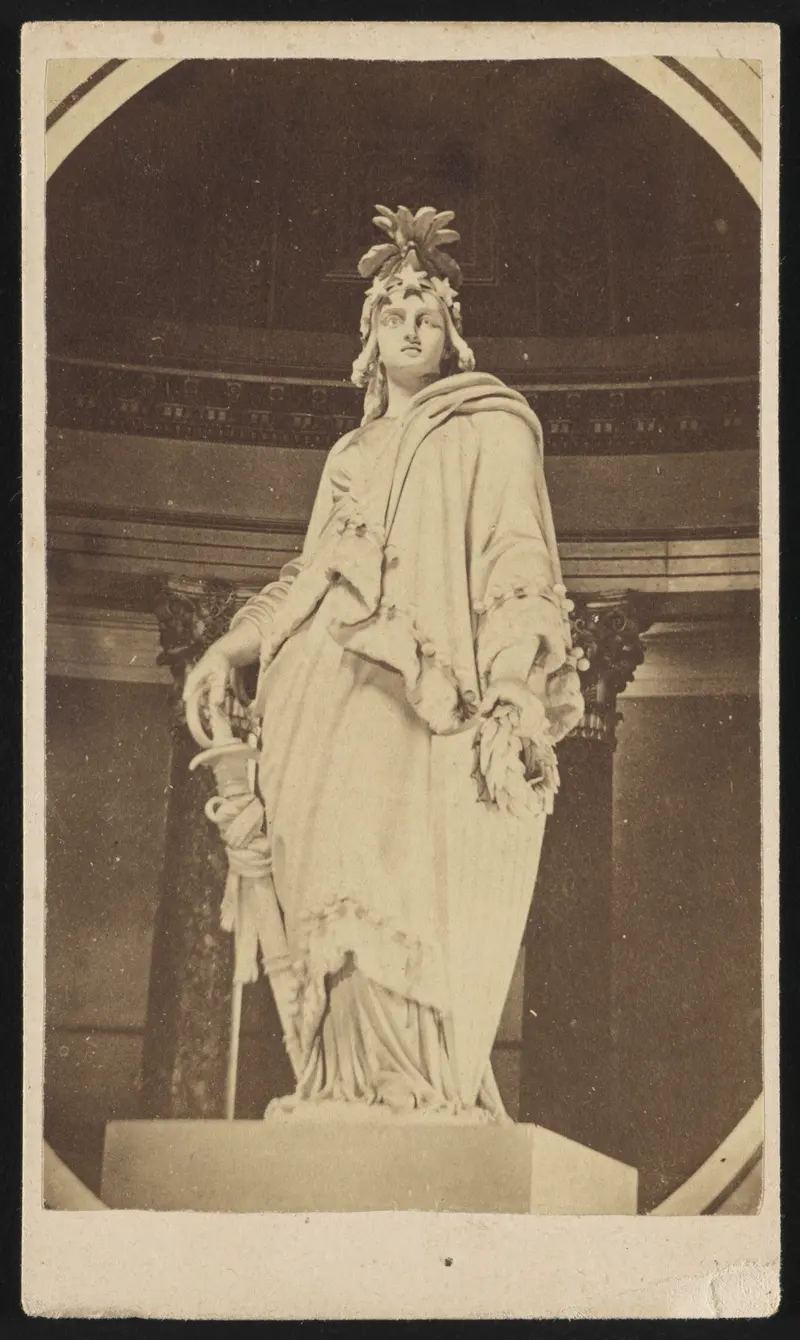
The plaster arrived in five sections and an Italian sculptor was hired to assemble it. When the model had to move from the Capitol to the foundry, no one knew how to separate it, and the Italian sculptor refused unless he was given a raise. Reid worked it out. A pulley and tackle on the lifting ring at the top of the model pulled the seams into view. The five sections went to the foundry. The Library of Congress summary of the photograph of that model (item 2023631991) says the same thing in one sentence: the plaster was on display in National Statuary Hall before it was cast in bronze, sculpted by Thomas Crawford and cast by Philip Reid, an enslaved artisan, in a foundry run by Clark Mills. The Library names him "Reid, Philip, approximately 1820–1892, caster." The print is an albumen carte de visite, about 1860, reproduction LC-DIG-ppmsca-88933, with no known restrictions on publication.
Reid was the only known enslaved worker on Freedom. He worked beside James A. Riddle, Peter Coyl, Resin (Rezin) Offutt, and Mikel Shedy (Michael Sheedy). He was paid directly for Sundays. His owner received the pay for the other six days. His rate was $1.25 a day. The other laborers received $1. From July 1, 1860, to May 16, 1861, he worked most weeks without a break and was paid $41.25 for 33 Sundays at $1.25, for "Keeping up fires under the moulds." He signed with an X. There are no known images of him. Mills described him, in the words quoted by the Architect of the Capitol, as "aged 42 years, mullatto [sic] color, short in stature, in good health, not prepossessing in appearance but smart in mind, a good workman in a foundry."
Free when the head went up
Work stopped in 1861 because of the Civil War. By the end of 1862 the statue was finished, with Reid's help, and displayed for a time on the Capitol grounds. The cost, not counting installation, was $23,796.82. Philip Reid received his freedom on April 16, 1862, when President Abraham Lincoln signed the Compensated Emancipation Act releasing certain persons held to service or labor in the District of Columbia. The Architect of the Capitol says it is not known whether Reid watched the installation, but he was a free man when the last piece, the head and shoulders, was raised on December 2, 1863. Thirty-five guns saluted, answered by the guns of the twelve forts around Washington. S.D. Wyeth, in The Federal City in 1865, is quoted on the same page: "Mr. Reed, the former slave, is now in business for himself, and highly esteemed by all who know him."
The bronze that stands on the dome is a different object from the plaster that was photographed in Statuary Hall. Carol M. Highsmith photographed the figure against the sky. The Library of Congress dates that transparency between 1980 and 2006 (item 2011633046, reproduction LC-DIG-highsm-14852) and states there are no known restrictions on publication. A note on that record says that on May 9, 1993, after almost 130 years in place, the bronze was taken off its pedestal by helicopter for restoration because of extensive pitting and corrosion. The plaster model, the Architect of the Capitol writes, weighs about 15,000 pounds, left the Capitol for the Smithsonian in 1890, was shown in the Arts and Industries Building from 1900 to 1967, and returned in 1992. It is now the centerpiece of Emancipation Hall in the Capitol Visitor Center.
Two prints in this shop come from those records. One is the 1860 photograph of Crawford's plaster, with Philip Reid named as caster. The other is Highsmith's photograph of the bronze on the dome. The Library of Congress does not endorse the shop. The sentences above are the records, not a speech put in Reid's mouth. No portrait of him is known, and none is invented here.