A story
Coney Island after dark
In 1905 Luna Park was outlined in about a quarter million electric bulbs. Five years later, the morning after the Fourth, a couple slept in the shade under the boardwalk. The shop has both pictures.
A park made of light
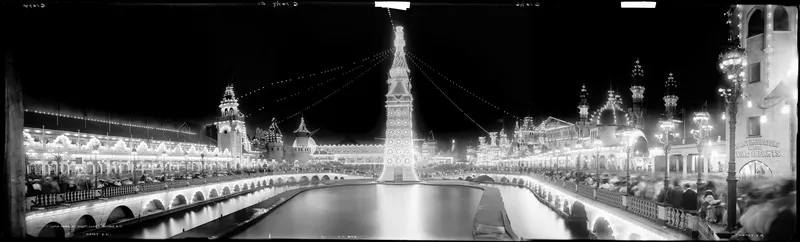
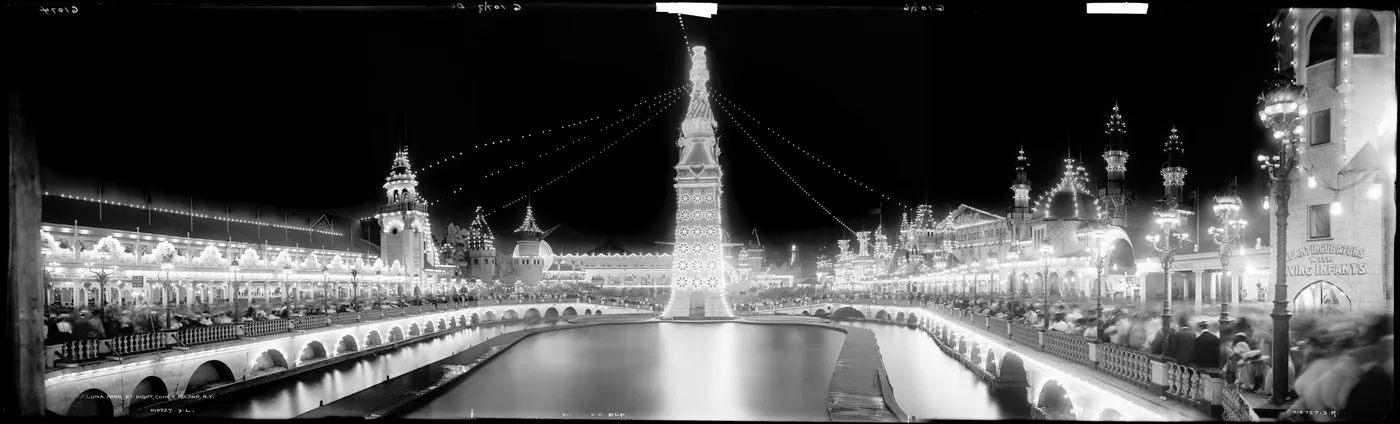
Luna Park opened at Coney Island in 1903, Frederic Thompson and Elmer Dundy's answer to the older towers and bathing pavilions along the beach. At night the park was the point. The Detroit Publishing Company photograph in the shop, made in 1905, shows the towers, the arches, and the minarets picked out in electric bulbs. The usual figure, the one the picture has carried for years, is about 250,000 lamps. In 1905 a great many American houses still lit the evening with gas or kerosene. A park that burned a quarter million bulbs was a new kind of public room.
Detroit Publishing sent photographers to make the view the way they made views of hotels and canyons, on a large negative, meant to be printed big. The file that survived into the Library of Congress Detroit Publishing holdings is the night panorama, the one catalogued from negative det.4a06541. It is wide because the park was wide. A tight crop would turn it into a single tower. The whole sweep is the subject: a beach resort deciding that darkness was an opportunity.
Coney was already a city of parks by then. Steeplechase had its sliding pavilion and its funny stairs. Dreamland, down the beach, had its own white towers and its own electric budget, until a fire in 1911 ended it. The picture here is Luna Park, the 1905 Detroit negative, and it should stay labeled that way. What the three parks shared was a bet. People would ride a train to the end of Brooklyn, stay past supper, and pay to walk around inside a light bulb.
The morning after the Fourth
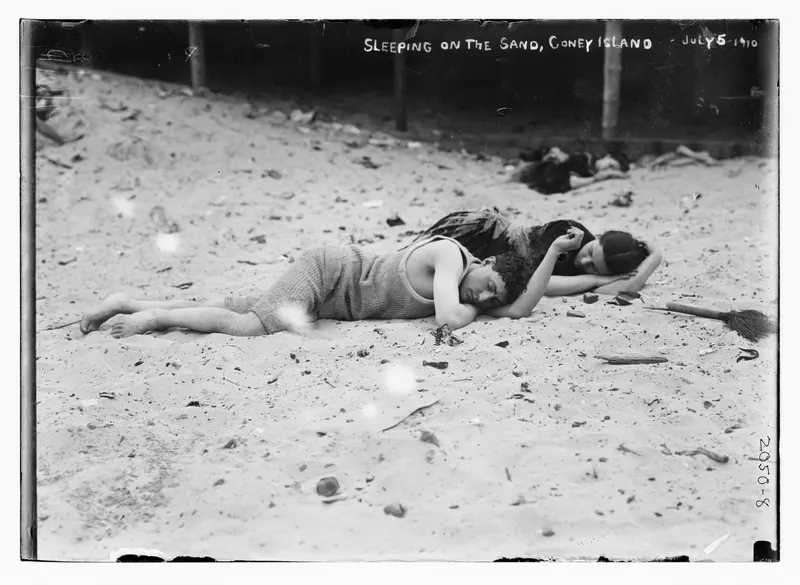
The second picture is quieter, and it is the necessary other half. On July 5, 1910, the Bain News Service made a photograph under the boardwalk. The caption on the glass negative is dated that day, the morning after Independence Day. A young man and a young woman in knit bathing suits have given up and fallen asleep in the shade. The Library of Congress files it as item 2014688305, Bain number ggbain.08314, negative LC-B2-2050-8. No known restrictions on publication.
George Grantham Bain sold pictures like this to newspapers all over the country. His service was a wire of human interest: parades, arrivals, strikes, and the occasional couple who had lost an argument with a holiday. July 4 at Coney was a crowded, loud, sandy piece of work. July 5, in the shadow of the boards, was the bill coming due. The knit wool suits, the slumped shoulders, the slice of shade: Bain's photographer took the day after, which is often the more truthful picture.
Hung together, the two frames are the same beach in two tempers. Luna Park is the promise, 1905, a quarter million bulbs, Detroit's wide negative. The sleepers are the morning, 1910, Bain's glass plate, two people who used the park the way people actually use a park. One is a spectacle. One is a nap. Coney Island after dark needs both, because the lights were only marvelous if somebody stayed late enough to be tired.
What to hang, and what the files say
Start with the night panorama. It wants width. Over a sideboard, across from a sofa, anywhere a person can step back, the towers read as a skyline and the bulbs read as weather. The Bain picture wants to be closer. Faces, wool, sand, the dated caption. Put it beside the panorama so the glamour has a witness.
Both are public-domain news pictures, one from Detroit Publishing and one from Bain, both now at the Library of Congress. The park in the night picture is Luna Park. The date on the sleepers is July 5, 1910. Those two facts are the whole caution a caption needs. The rest is the pleasure of a beach that figured out electricity, and of a couple who figured out the shade.