

A story
Buffalo Bill's Wild West
William F. Cody took a show called Buffalo Bill's Wild West across America and Europe. The posters in the shop are the advertisements: broncs, a night arena, a French tour, and the rival who later joined him.
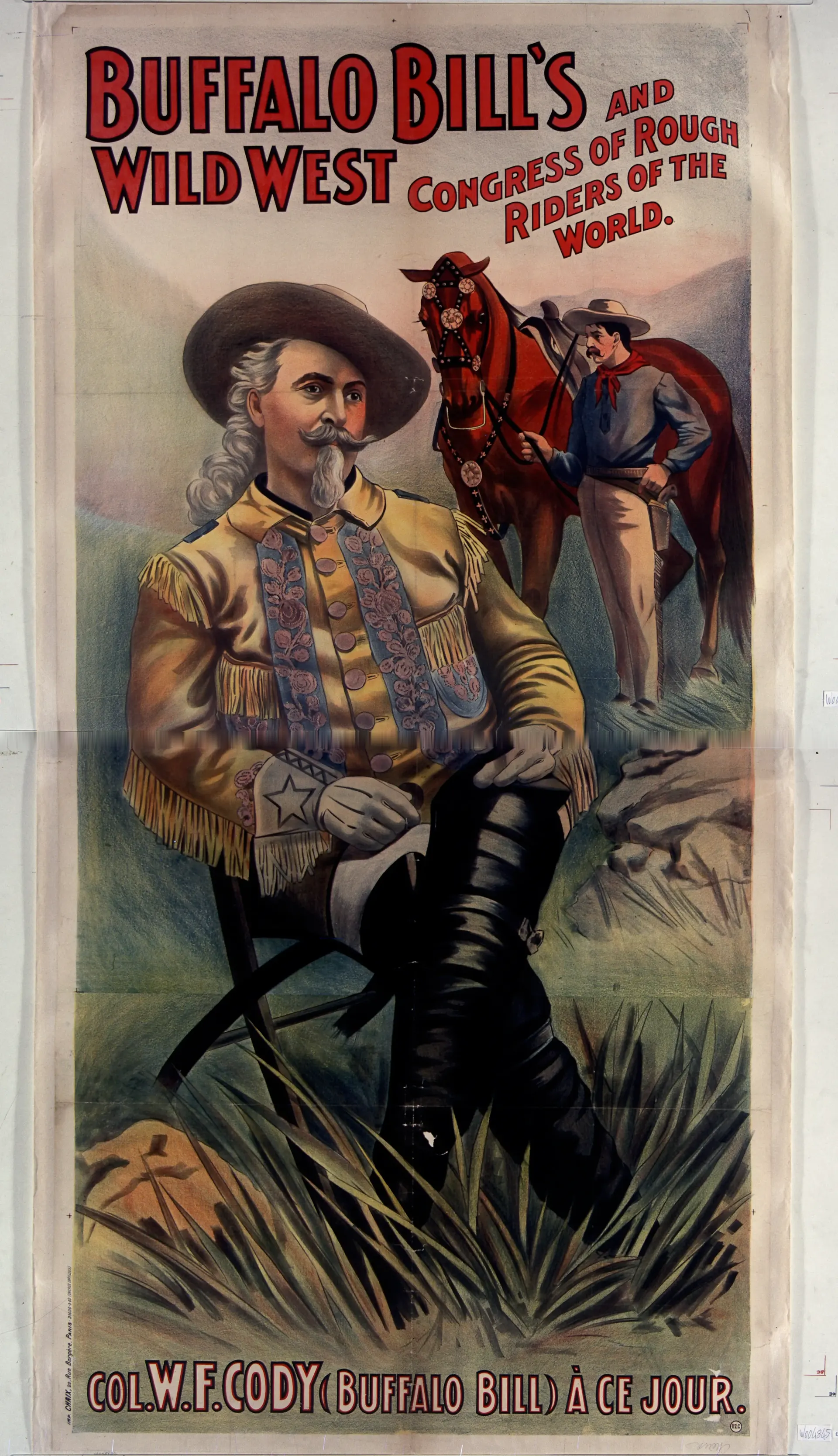
A show with a printer
Buffalo Bill's Wild West opened in Omaha in 1883. William F. Cody, who had been a scout and a hunting guide and already a character in dime novels, put ranch work, marksmanship, and a staged prairie into an arena and took it on the road. Annie Oakley joined the company. The show crossed to Europe, played for huge crowds, and came home again. By the time the posters in this group were printed, the Wild West was the most famous American entertainment a European city was likely to see, and it was also a business that lived on paper stuck to walls.
The paper is what we have. The acts are gone. A lithograph had to explain a ticket in one glance: a horse in the air, a face with long hair, a promise that the thing inside the tent was the real West. The artists who drew them were selling seats. They were also, whether they meant to or not, drawing the West that people who never went there would remember.
France, 1905, and the face everyone copied
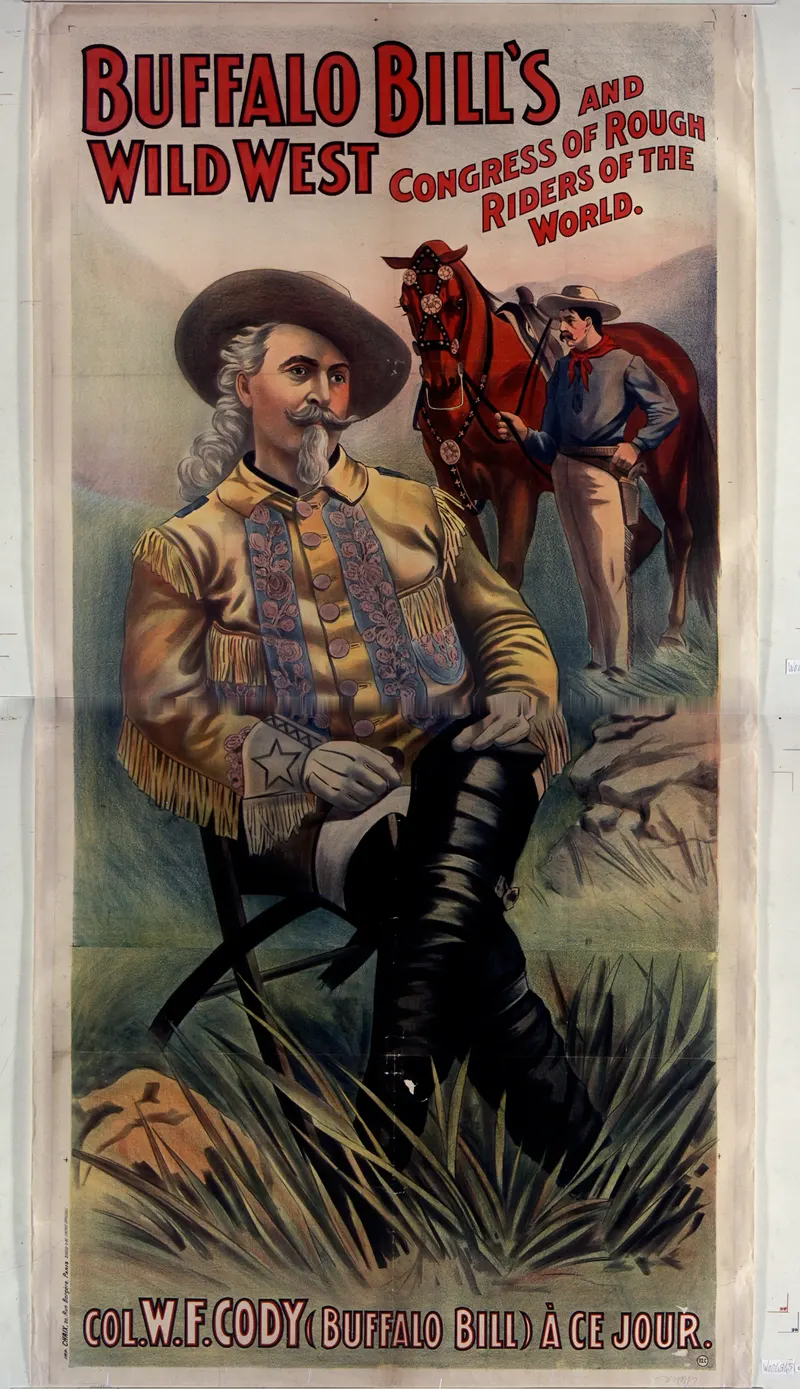
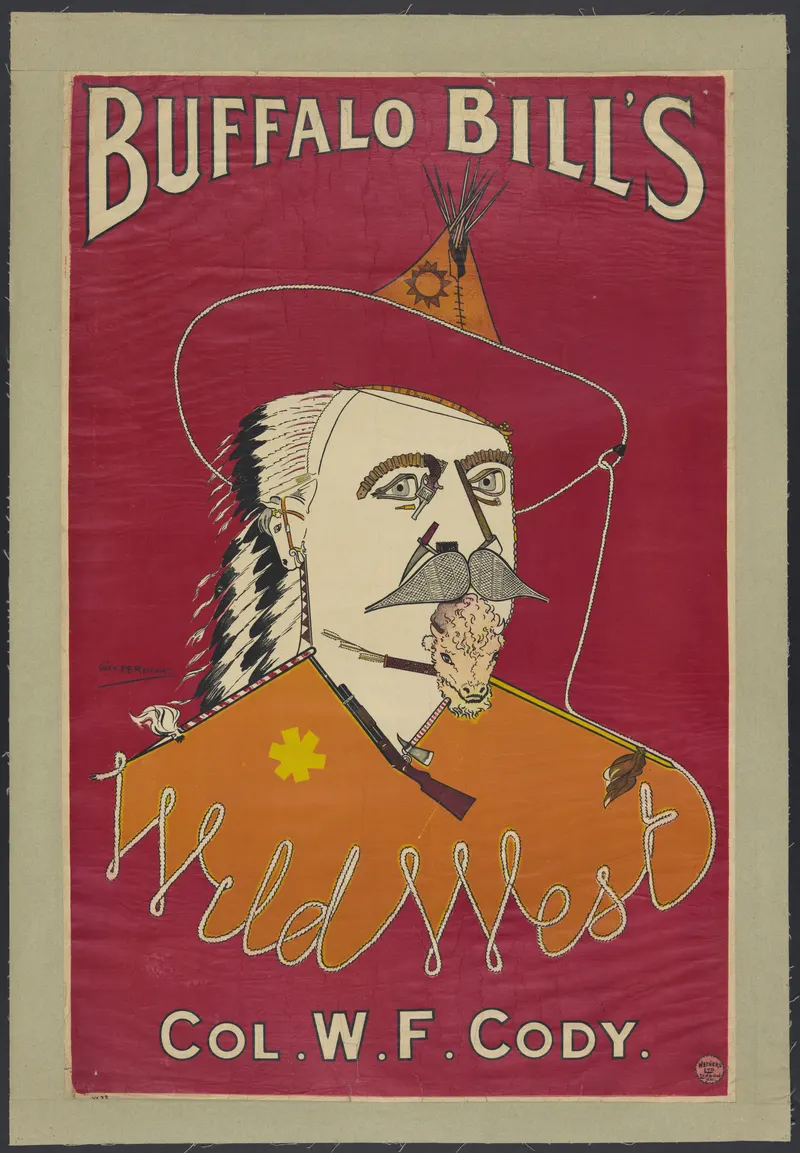
The tall portrait that opens this story was printed for the show's 1905 tour of France. Cody is the monument in the middle. The Bibliothèque nationale de France holds the sheet, scanned through Gallica. The artist is unidentified. The job of the poster is simple and enormous. It says the colonel is in town.
Fifteen years earlier, Alick P.F. Ritchie had drawn a different solution to the same problem. His 1890 poster puts Cody's face among the faces of the troupe, a company portrait arranged like a medal. The Library of Congress files it as LCCN 95510992. It was copied so widely that it became a default image of Buffalo Bill: the goatee, the hat, the calm of a man whose name was already a trademark. Hung beside the 1905 French sheet, Ritchie's poster shows the brand before that particular tour, and the French sheet shows the brand still working after another decade of miles.
Broncs, a giant ball, and a night arena
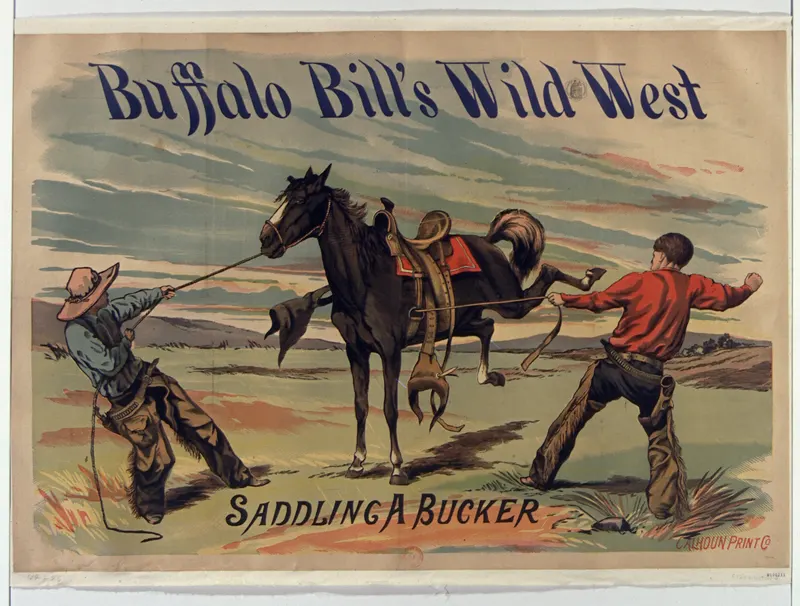
Saddling a bucker, a sheet from about 1890 also in the Gallica scan, sells the bronc ride as pure danger. A cowboy reaches for a horse that has already decided against him. Ranch work had a version of this every time a string was started. Cody's arena turned it into a spectator sport, and a lot of the riders who learned to stay on in shows like his later shaped what became rodeo. The poster does not say that. It says: watch this horse.
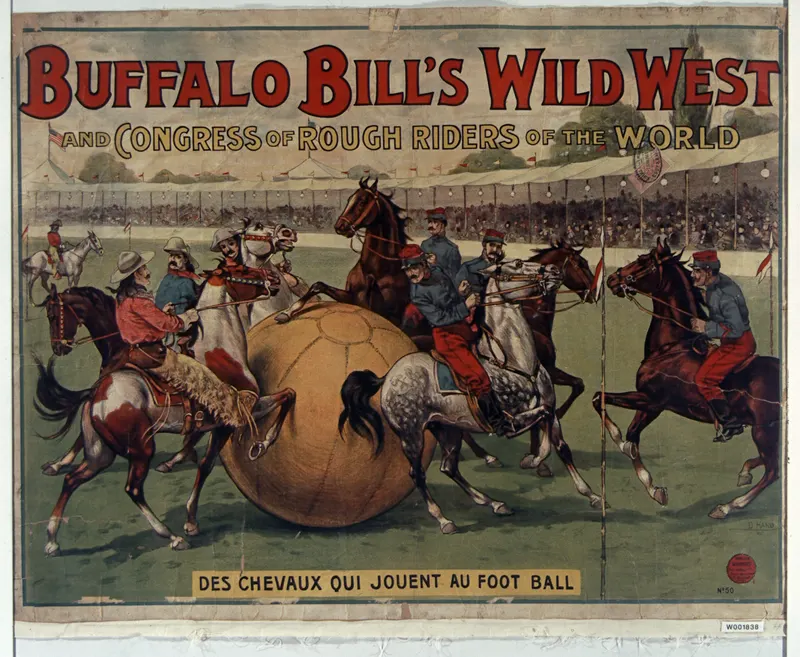
The football poster, drawn by an artist credited as O'Hand, is the proof that the Wild West was also a circus. Riders push a giant ball around the arena on horseback. French audiences loved it. The sheet from about 1890 advertises the nonsense with a straight face, which is the right face. If you only know Cody from the solemn portraits, this one corrects you. The same company that reenacted prairie battles also played cowboy football.
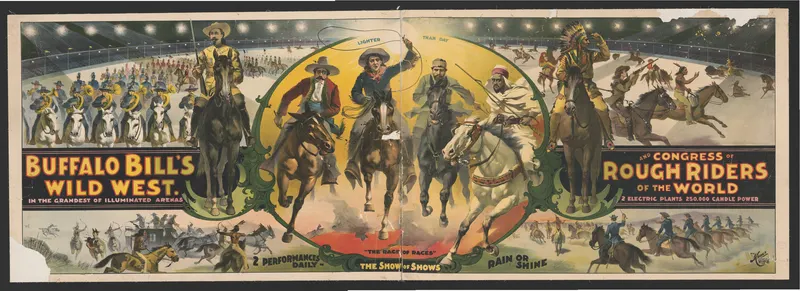
By the middle 1890s the show had an answer for sundown. A poster for Buffalo Bill's Wild West and Congress of Rough Riders of the World advertises an illuminated arena: two electric plants, 250,000 candlepower, so the performance could run at night. The Library of Congress holds it as LCCN 2002719218. Electric light at that scale was still a marvel. Most towns the show passed through did not glow like that arena. The poster is a panorama for a reason. It wants a long wall, the way the arena wanted a long evening.
The rival on his own paper
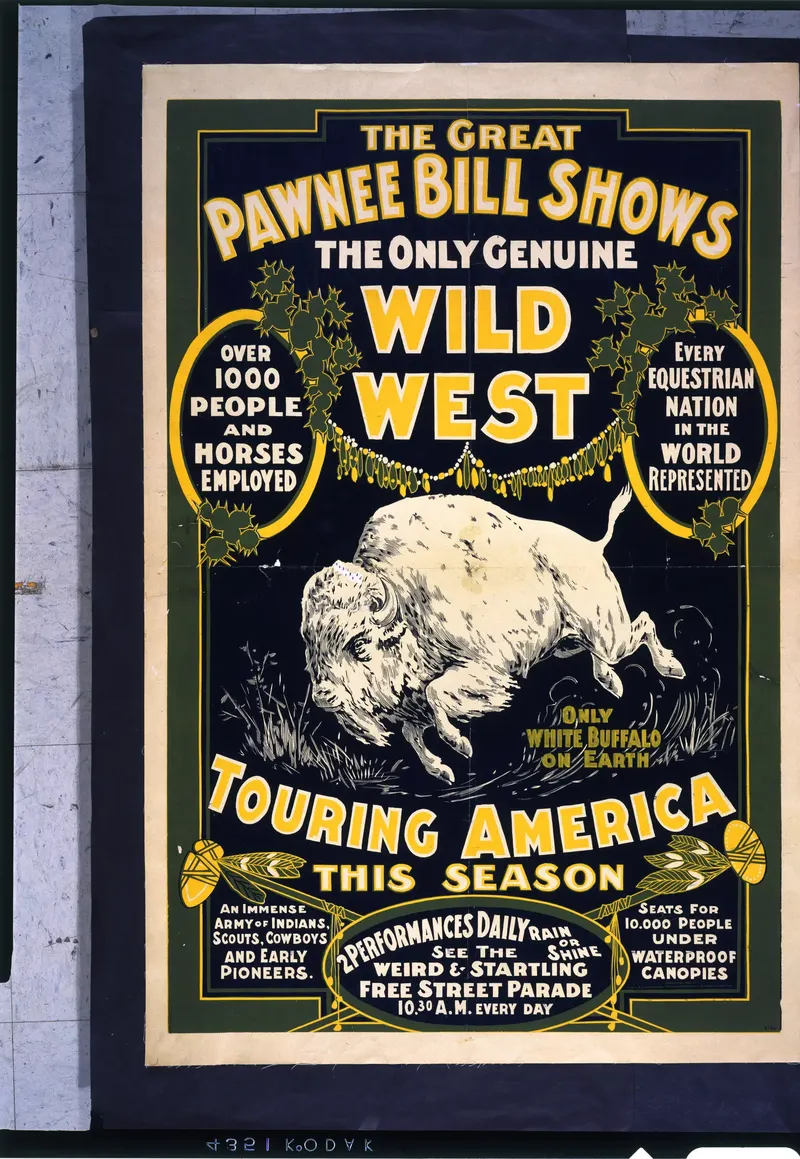
Gordon W. Lillie, who performed as Pawnee Bill, ran the main competing wild-west show. His 1903 poster, Library of Congress LCCN 94504458, calls the production the only genuine wild west, a phrase aimed straight at Cody. The jab was good advertising. It was also temporary. In 1908 the two companies merged, and for a few seasons the rival printer's boasts shared a single train.
Six sheets, then, and a clear way to hang them. The 1905 Cody is the tall face. Ritchie's 1890 is the company. The bronc and the football ball are the acts. The illuminated arena is the night. Pawnee Bill is the argument from across the street. All of them are advertisements that outlived the tents. Gallica and the Library of Congress kept the paper. The shows themselves folded into the history of rodeo, of the circus, and of a West that was already changing while the posters still promised it was just outside.
Shop the story
No. 244 · Wild West Show Posters
Buffalo Bill's Wild West, Col. W.F. Cody poster, 1905
Studio lithograph
From $34
No. 245 · Wild West Show Posters
Saddling a Bucker, Buffalo Bill's Wild West poster, c.1890
Studio lithograph
From $29
No. 246 · Wild West Show Posters
Horses Playing Football, Buffalo Bill's Wild West poster, c.1890
Illustrated by O'Hand
From $29
No. 247 · Wild West Show Posters
Col. W.F. Cody, Buffalo Bill's Wild West, 1890
Illustrated by Alick P.F. Ritchie
From $34
No. 271 · Wild West Show Posters
Buffalo Bill's Wild West & Congress of Rough Riders: Illuminated Arena, c.1894
Studio lithograph
From $149
No. 248 · Wild West Show Posters
The Great Pawnee Bill Shows, 1903
Studio lithograph
From $29
Sources
- Buffalo Bill's Wild West, Colonel W.F. Cody, 1905 French tour poster, Gallica / Bibliothèque nationale de France
- Saddling a bucker, Buffalo Bill poster, about 1890, Gallica
- Horses playing football, poster by O'Hand, about 1890, Gallica
- Col. W.F. Cody, Alick P.F. Ritchie, 1890, Library of Congress LCCN 95510992
- Illuminated arena poster, two electric plants, 250,000 candlepower, Library of Congress LCCN 2002719218
- The Great Pawnee Bill Shows, 1903, Library of Congress LCCN 94504458


