

A story
Twelve seconds at Kitty Hawk
On December 17, 1903, Orville Wright flew for twelve seconds and John T. Daniels, who had never taken a photograph, pressed the shutter. The shop follows that airplane to Fort Myer, to Lindbergh, and up the Empire State.
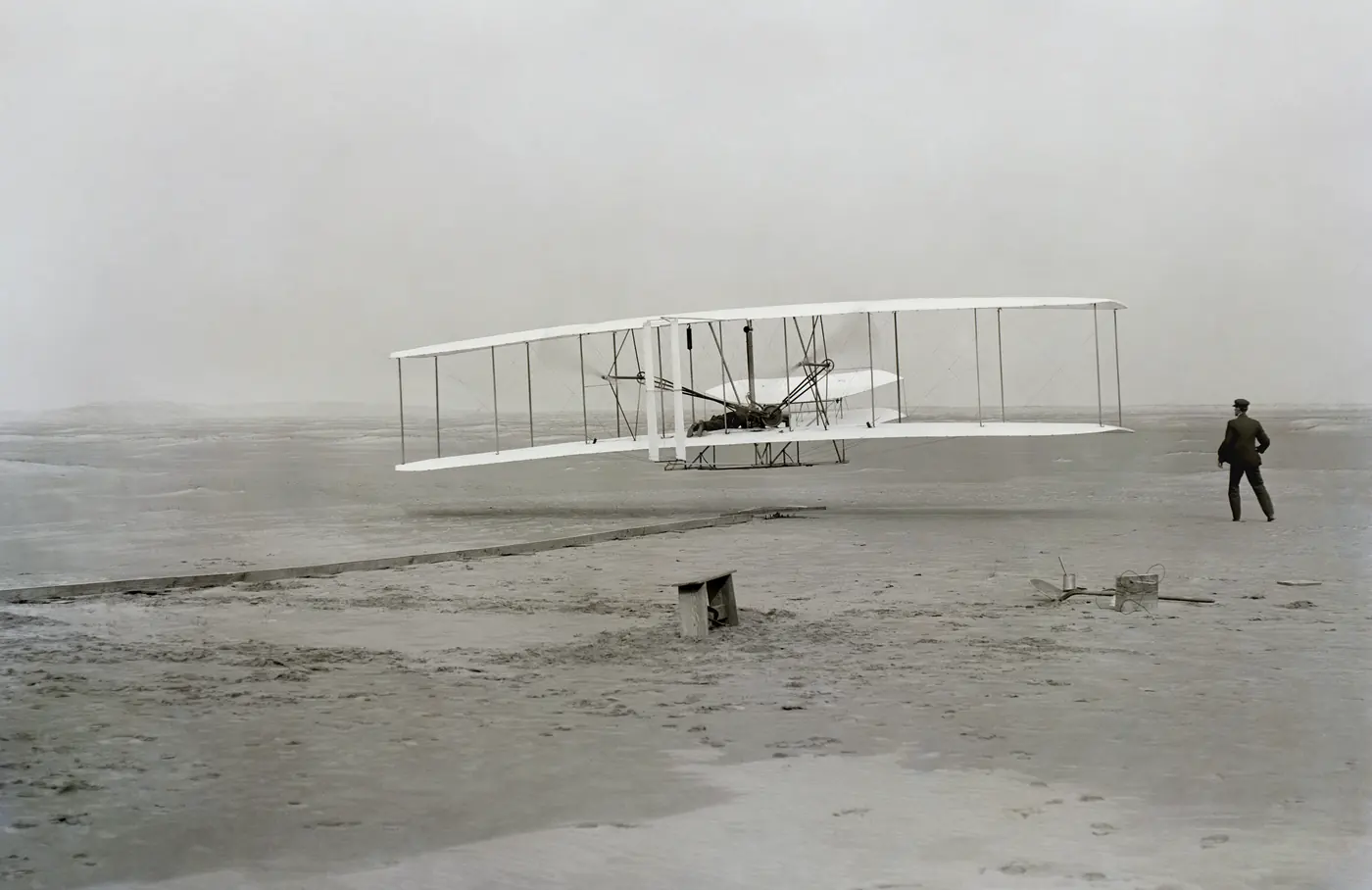
A rail, a bulb, and twelve seconds
On the morning of December 17, 1903, at Kill Devil Hills near Kitty Hawk, the Wright brothers flew the first powered, controlled, heavier-than-air machine. Four flights, the same day, each longer than the one before. The first lasted twelve seconds and covered 120 feet. Orville was at the controls, lying prone, his hips in the cradle that warped the wings. Wilbur ran alongside and had just let go of the forward upright. The Library of Congress holds the glass negative. The title in the catalog is the measurement: first flight, 120 feet in 12 seconds, 10:35 a.m.
John T. Daniels of the Kill Devil Hills Life-Saving Station pressed the shutter. He had never taken a photograph. Orville had set the camera on a tripod, aimed it at the point where he hoped the machine would leave the rail, and told Daniels when to squeeze the rubber bulb. Daniels did it. The negative, LC-DIG-ppprs-00626, is item 00652085 in the Library's Wright brothers collection, no known restrictions on publication. Three more flights followed. The fourth, with Wilbur flying, lasted 59 seconds and went 852 feet. The picture the world remembers is the first one, because Daniels was there and the bulb worked.
Fort Myer, for the Army
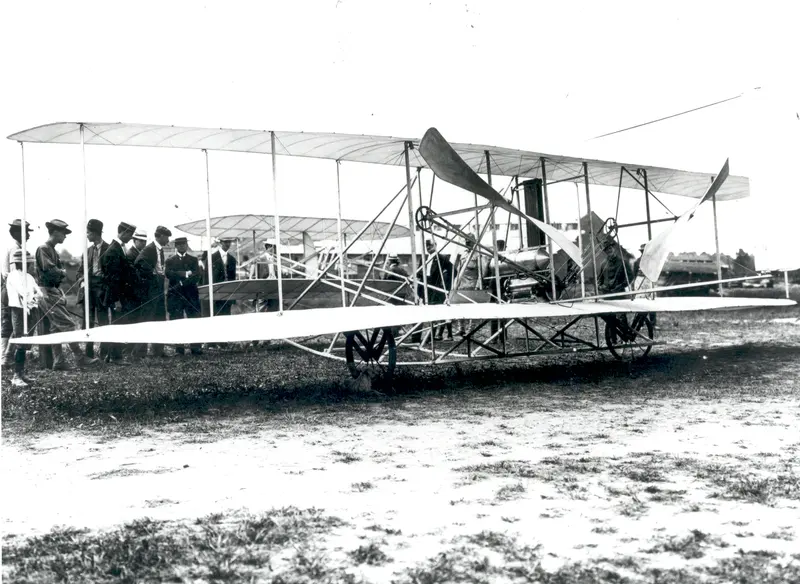
The Army wanted an airplane of its own. In 1908 Orville brought a machine to Fort Myer, Virginia, for the Signal Corps trials: a two-person aircraft that could stay up long enough, and go fast enough, to be useful. The photograph in the shop is dated September 3, 1908, a demonstration flight, Orville in the air over the fort's field. The trials were the serious sequel to Kitty Hawk. A twelve-second hop had proved the machine. Fort Myer was where the government decided to buy one.
The September 3 picture is the flight, not the accident. Later that month, on September 17, a propeller failure crashed the airplane, injured Orville, and killed his passenger, Lieutenant Thomas Selfridge, the first person to die in a powered airplane. The shop's frame is the earlier date, the machine doing what it had been asked to do, above a military post, with the Washington skyline of sheds and trees underneath. Hang it to the right of Daniels's picture and the five years between them are visible. The rail in the sand becomes a field with spectators.
A periscope over the Atlantic, and a man on a cable
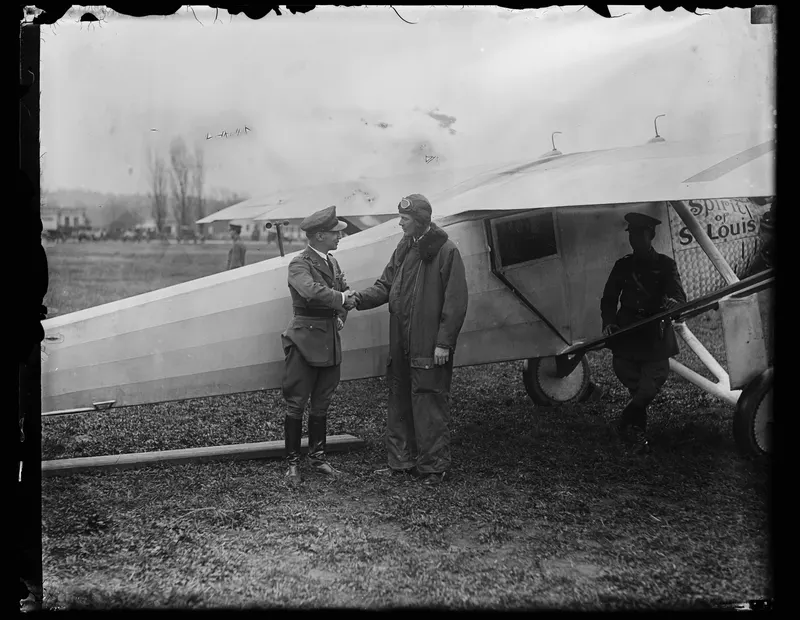
Charles Lindbergh flew the Spirit of St. Louis from New York to Paris on May 20 and 21, 1927. The airplane had no forward window. An extra fuel tank sat in front of the pilot, and he watched the horizon through a periscope. The Harris & Ewing glass plate in the shop, Library of Congress LCCN 2016888581, shows Lindbergh and the silver airplane, the tank's logic written in the blank nose. Twenty-four years after a twelve-second flight, a single engine stayed up all night because somebody had been willing to give up the view.
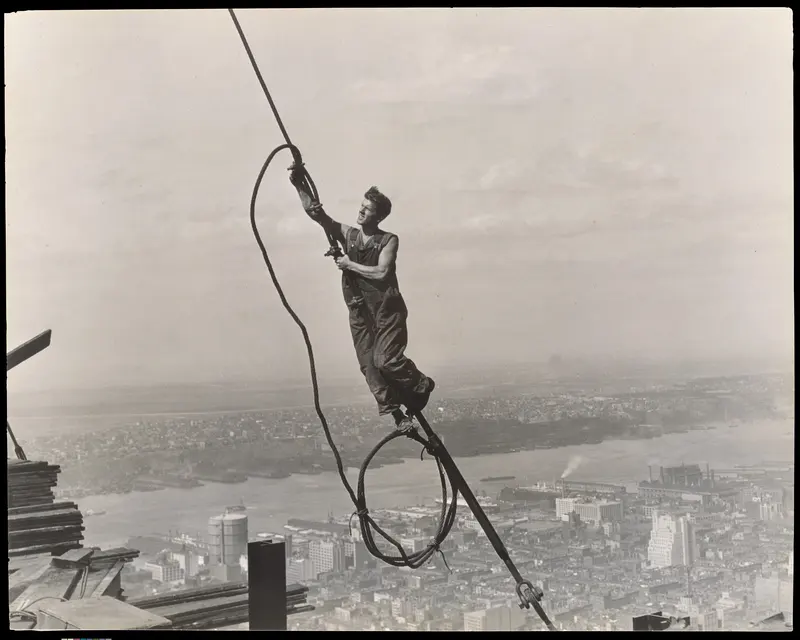
Lewis Hine's Icarus, 1930, is the last step in this particular story, and it is not an airplane. Hine was hired to photograph the construction of the Empire State Building. The Metropolitan Museum's print shows a steelworker swung out on a cable, high over Manhattan, the city far enough below that the title Hine's picture picked up, Icarus, feels earned. The building opened on May 1, 1931. The worker in the photograph is doing with a cable what the Wrights had done with a wing: trusting a calculation, in public, at a height that makes a crowd look up.
Four pictures, one line. Daniels's bulb at Kill Devil Hills. Orville over Fort Myer on September 3, 1908. Lindbergh and a nose full of gasoline. Hine's steelworker, 1930, a quarter mile of air under his boots. Flight, in this hang, is a machine and then a building, the same dare moved from a dune to a city. The Library of Congress holds Daniels's negative, a NASA Great Images file holds the Fort Myer photograph, Harris & Ewing made the Lindbergh plate, and the Met holds Hine's print. The twelve seconds are still the start.
Shop the story

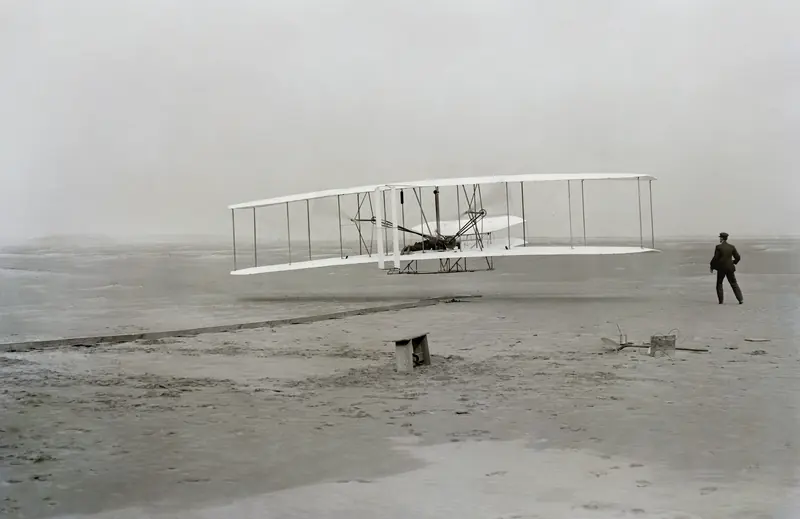
No. 004 · Great Moments
First Flight
Photographed by John T. Daniels
From $34
No. 019 · Firsts
The Wright Flyer at Fort Myer
Source: NASA Great Images (GRIN) copy
From $199

No. 183 · Wings
Lindbergh and the Spirit of St. Louis, 1927
Photographed by Harris & Ewing
From $29
No. 025 · Famous Americans
Icarus, High Above New York
Photographed by Lewis Hine
From $29
Sources
- First flight, 120 feet in 12 seconds, December 17, 1903, John T. Daniels, Library of Congress item 00652085
- Wright Flyer at Fort Myer, Virginia, September 3, 1908
- Charles Lindbergh and the Spirit of St. Louis, 1927, Harris & Ewing, Library of Congress LCCN 2016888581
- Lewis Hine, Icarus, Empire State Building, 1930, The Metropolitan Museum of Art


