

A story
The Tuskegee Airmen at Ramitelli
One picture in this group is the 332nd Fighter Group at Ramitelli, Italy, in March 1945. The others are the home front and the day the war stopped: a Douglas factory, a Westinghouse poster, and Times Square.
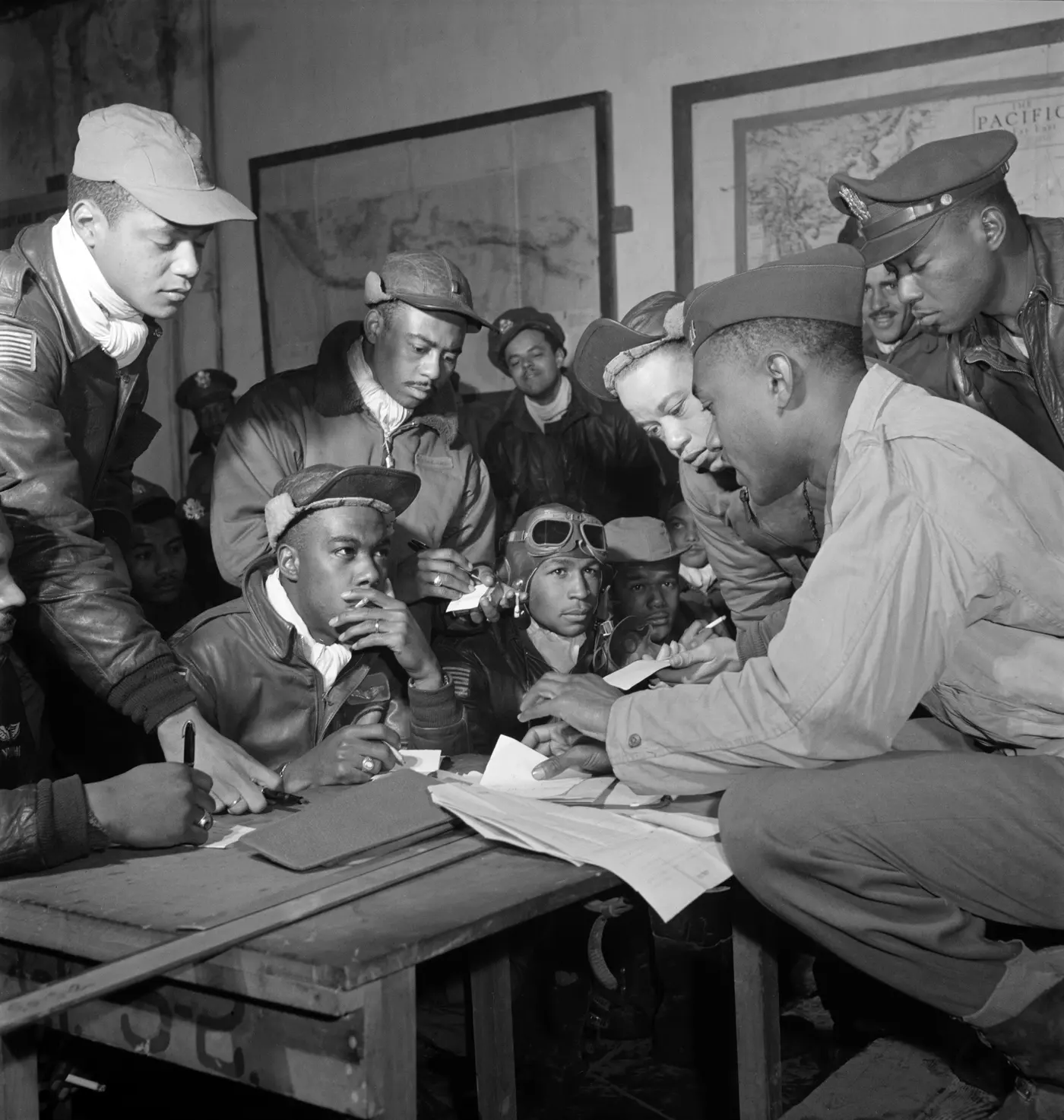
The group, named as a group
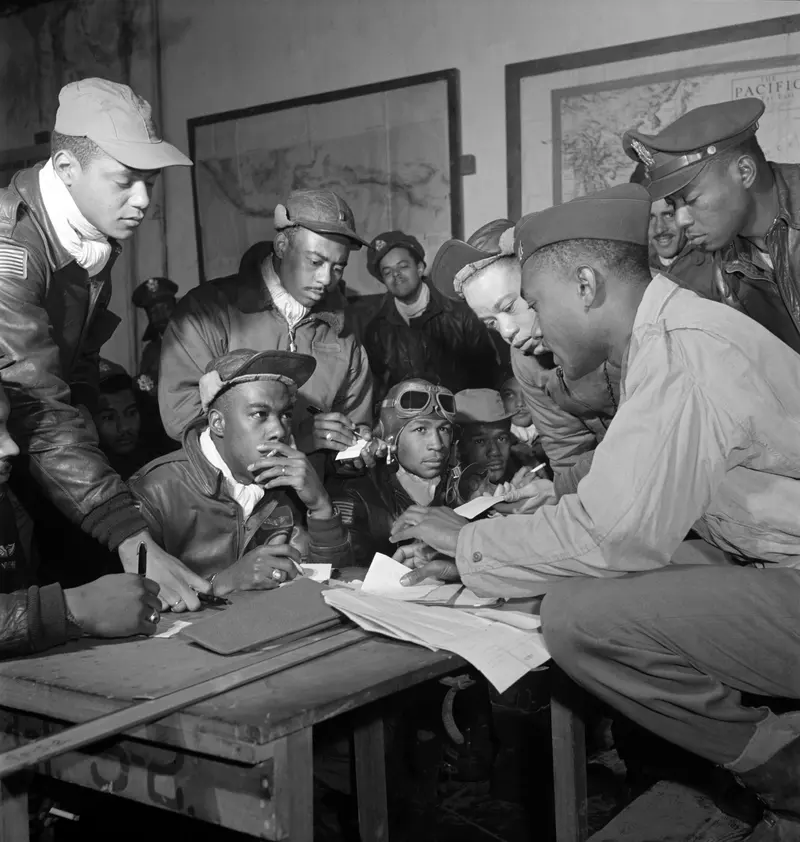
The photograph that opens this story shows pilots of the 332nd Fighter Group, the fighter group trained at Tuskegee, standing at Ramitelli, Italy, in March 1945. The Library of Congress print the shop uses carries that place and that month. The red tails on their Mustangs were the group's mark in the last year of the war in Europe, which is why people say Red Tails. The picture is a group. It does not come with a roll call printed on the negative the shop sells, and this story will not invent one. They are the 332nd, in Italy, late in the war.
The Tuskegee program had begun as an experiment the Army Air Forces did not uniformly want, a segregated training field in Alabama for Black pilots and the ground crews who kept the airplanes flying. By March 1945 the experiment had been a combat group for years, flying escort over Europe from that Italian field. The photograph is the evidence a wall can hold: men in flight clothes, a place name, a month. Ramitelli. March 1945. The rest of the record is in the archives, pilot by pilot, and it should be read there.
Long Beach, October 1942
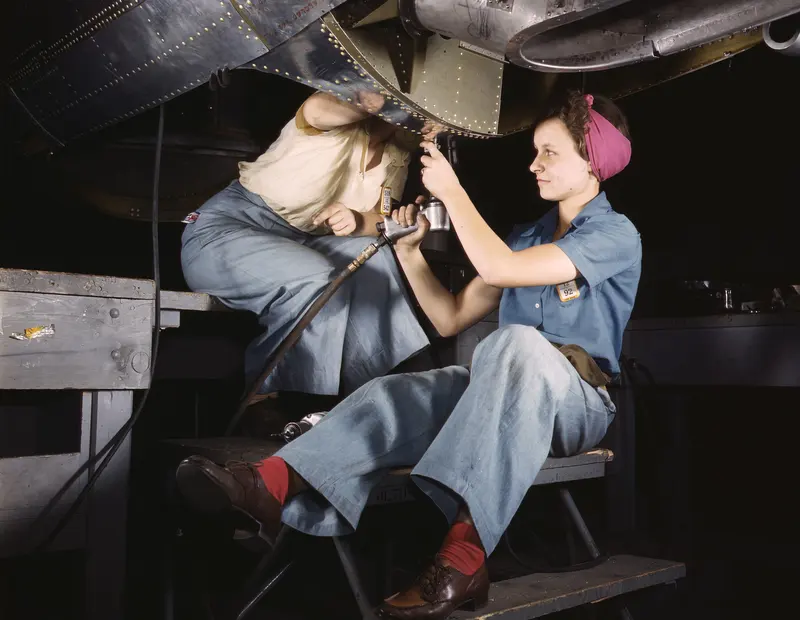
The second picture is not Italy and not a pilot. In October 1942 Alfred T. Palmer, working in color for the Office of War Information, photographed women machining parts at the Douglas Aircraft plant in Long Beach, California. The Library of Congress holds the transparency. Palmer's color is rich because the OWI wanted the arsenal to look like a place of skill, and because color film in 1942 was still a statement. The women are at the machines. The bombers they were building are the reason for the shift.
Palmer's frame belongs beside the Ramitelli picture because a fighter group is an industrial fact as well as a military one. Somebody machined the metal. The Long Beach photograph says who, in that plant, in that month. It is a home-front picture. The pilots are the overseas picture. Keeping the captions apart is the respect both groups are owed. Douglas, Long Beach, October 1942, Alfred Palmer, Office of War Information. 332nd Fighter Group, Ramitelli, March 1945.
A poster inside a factory, and a kiss in Times Square
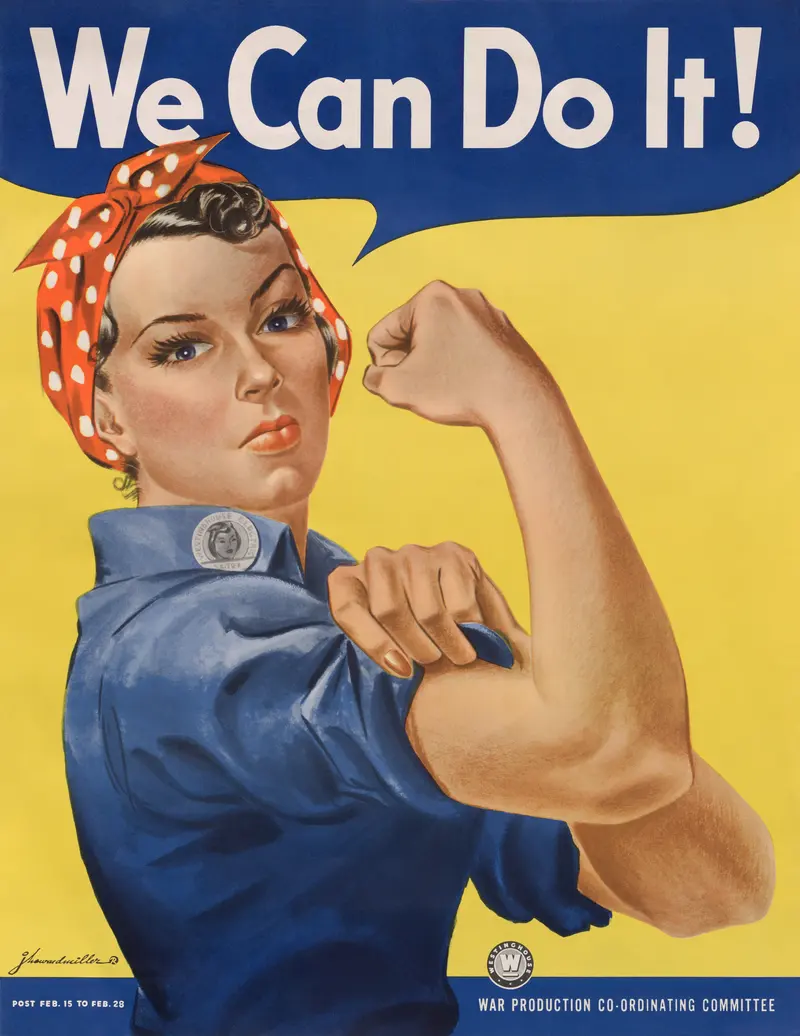
We Can Do It! is J. Howard Miller's 1943 poster for Westinghouse, the one the National Archives files as 535413. Westinghouse commissioned it for display inside its own plants, a morale poster for people already on the payroll, not a national recruiting billboard. Later decades adopted the figure as a general face of wartime women workers. The original job was narrower, and more interesting for being narrow: a company talking to its own floor. Hung next to Palmer's Douglas photograph, the poster is the graphic and the photograph is the shop floor. They are cousins, not the same picture.
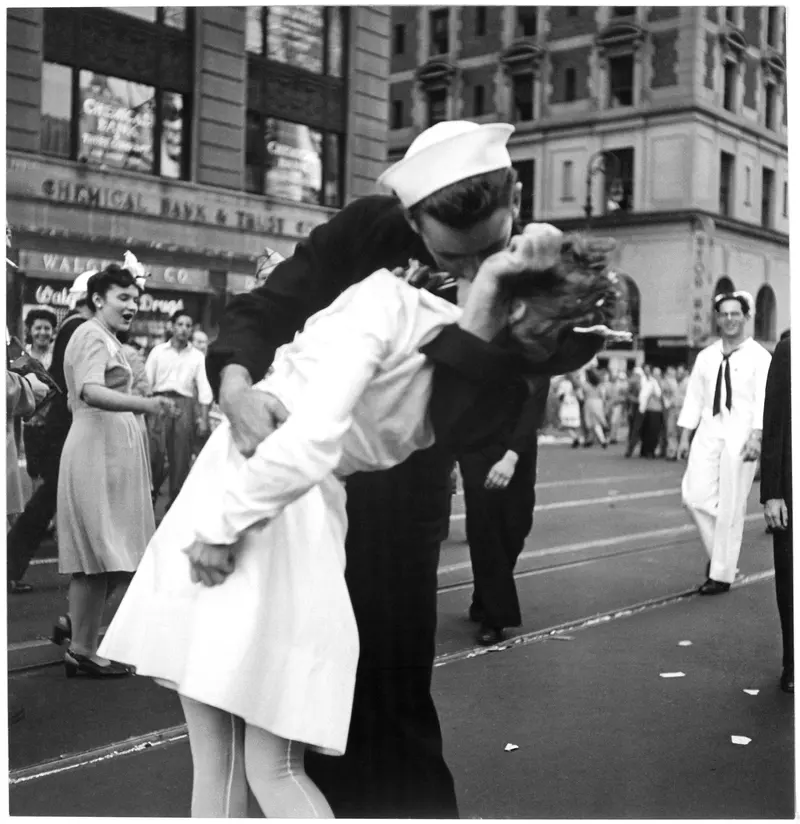
The last frame is the day the fighting stopped. On August 14, 1945, Times Square filled at the news of Japan's surrender. Navy photographer Victor Jorgensen, in the crowd, made the photograph of a sailor and a nurse that the shop sells. Alfred Eisenstaedt, working for Life, made a different frame in the same square on the same day. The print here is Jorgensen's. The identities of the two people were argued over for years afterward, which is a reason to let the photograph stay a photograph: a uniform, a white dress, a street, V-J Day.
Four pictures, four jobs. The fighter group in Italy. The machinists at Douglas. The poster Westinghouse hung indoors. The Navy photographer in Times Square when the war was over. A wall that tells it in that order moves from the field to the factory to the announcement to the afternoon it ended. The sources below keep the archives straight. The 332nd stays a group until a record in front of you names a face.
Shop the story

No. 028 · Famous Americans
The Tuskegee Airmen
Photographed by Toni Frissell
From $29
No. 027 · Famous Americans
Women Who Built the Bombers
Photographed by Alfred T. Palmer
From $29

No. 026 · Famous Americans
We Can Do It!
Illustrated by J. Howard Miller
From $29
No. 029 · Firsts
Kissing the War Goodbye
Photographed by Victor Jorgensen
From $29
Sources
- Pilots of the 332nd Fighter Group, Ramitelli, Italy, March 1945, Library of Congress
- Women machining parts at Douglas Aircraft, Long Beach, October 1942, Alfred T. Palmer, Office of War Information, Library of Congress
- J. Howard Miller, We Can Do It!, 1943, National Archives 535413
- Victor Jorgensen, Times Square, August 14, 1945, U.S. Navy


