A story
The Shaw Memorial and the 54th
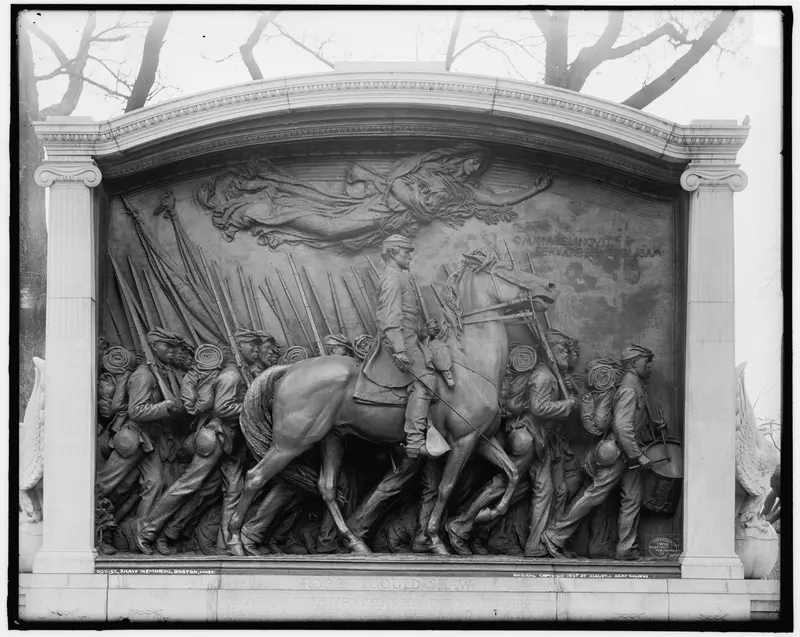
Augustus Saint-Gaudens spent nearly fourteen years on the high-relief bronze to Colonel Robert Gould Shaw and the Massachusetts 54th. It was unveiled on Boston Common on May 31, 1897. Detroit Publishing photographed it about 1906.
The regiment
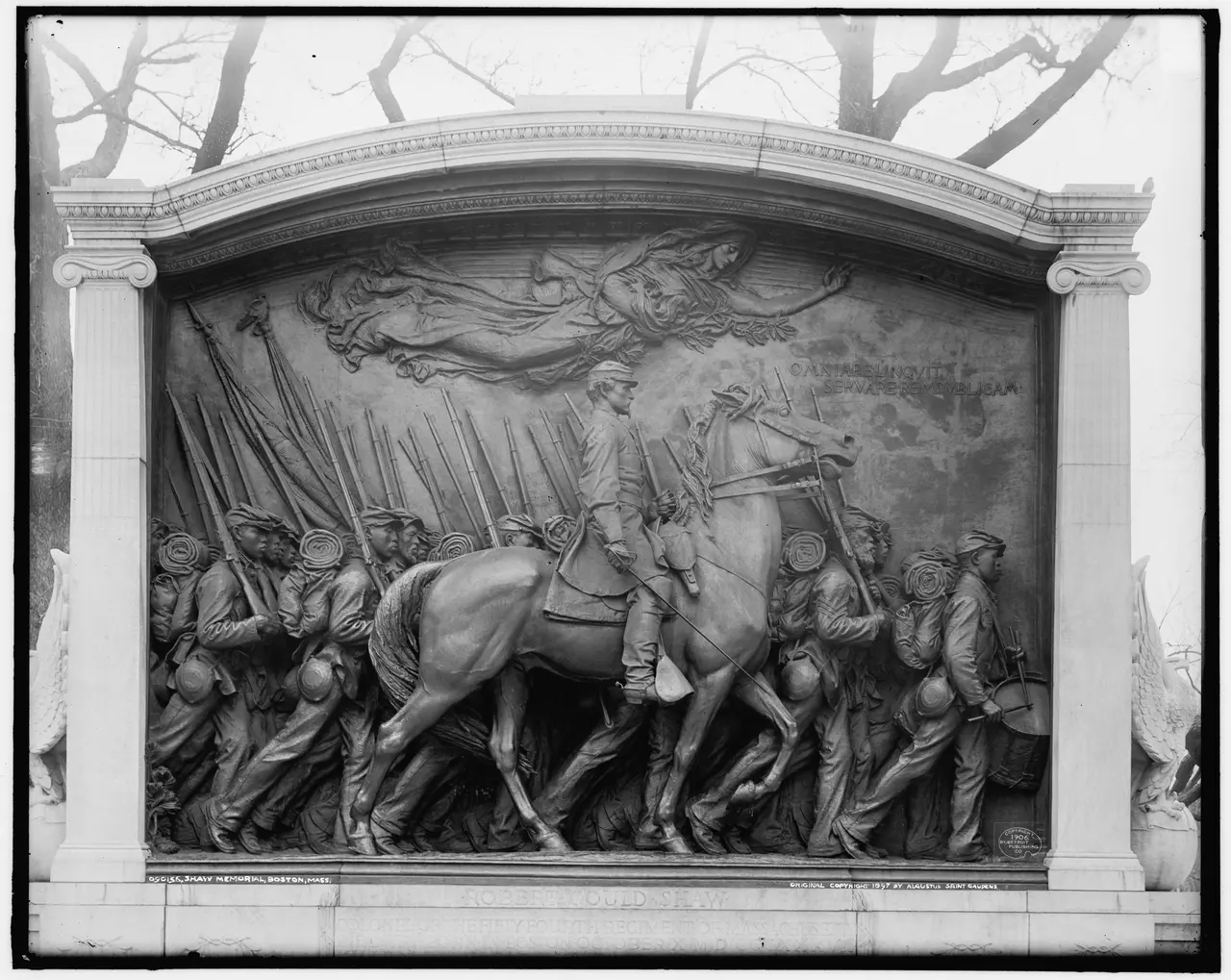
The National Park Service page for Boston African American National Historic Site says the Robert Gould Shaw and Massachusetts 54th Regiment Memorial commemorates one of the first Black regiments of the American Civil War. African Americans had served in the Revolutionary War and the War of 1812, the page says, but Northern racist sentiments kept them from taking up arms for the United States in the early years of the Civil War. A clause in Abraham Lincoln's 1863 Emancipation Proclamation allowed Black regiments to be raised. Governor John Andrew created the Massachusetts 54th Volunteer Infantry and chose Robert Gould Shaw, the son of wealthy abolitionists, as its colonel. Frederick Douglass and Lewis Hayden were among those who recruited. Men enlisted from every region of the North, and from Canada and the Caribbean.
On July 18, 1863, the regiment assaulted Fort Wagner, South Carolina. Shaw and many of his men died. The Park Service says the assault helped erode Northern public opposition to Black soldiers and inspired the enlistment of more than 180,000 Black soldiers into United States forces. Sergeant William H. Carney, severely injured, saved the regiment's flag and became the first African American recipient of the Medal of Honor. The 54th also fought on James Island, at Olustee, and at Honey Hill, and returned to Boston in September 1865.
Fourteen years, then Beacon Street
A longer Park Service article on the memorial says calls for a monument began in 1863, soon after the Second Battle of Fort Wagner, and names the Black Bostonian Joshua Bowen Smith as the person historians largely regard as the originator. In 1865 Charles Sumner argued that the monument belonged in Massachusetts. The article quotes him: "The monument should be in Massachusetts, where the martyr was born, and where the regiment was born also." He wanted bronze, and an equestrian statue, on the steps from Beacon Street to the State House. Governor Andrew called a meeting. A committee of 21 formed, including Sumner, Smith, and the Beacon Hill minister Leonard Grimes. The work then stalled for more than a decade. In August 1882 the committee commissioned Saint-Gaudens.
The Boston site page says he took nearly fourteen years, hired forty men in his New York studio to model the soldiers' faces, and was paid by private donations. The memorial was unveiled on May 31, 1897. It shows the 54th as they marched down Beacon Street in 1863, and it stands on Boston Common directly across from the Massachusetts State House. The article adds that the bronze, 11 by 14 feet, was installed on May 21 under Saint-Gaudens' supervision, that veterans of the 54th led the procession on unveiling day, and that Sergeant William Carney carried the flag. Shaw's sister, Josephine Lowell, had asked that the names of all the men of the 54th killed at Fort Wagner and afterward go on the base. The article says the original inscriptions named only the white officers, and that this was rectified in the early 1980s.
The photograph in the shop is not the unveiling. It is a Detroit Publishing Co. glass negative, about 1906, Library of Congress item 2016810347, an 8 by 10 inch dry plate, reproduction LC-DIG-det-4a25020, Detroit number 090156. The negative carries the line "Original copyright 1897 by Augustus St. Gaudens." Saint-Gaudens is named as a contributor. Subjects include Robert Gould Shaw. The rights line is no known restrictions on publication. The print is that plate: the relief, nine years after it was uncovered, still on the Common.