

A story
Lincoln seated, and Lincoln in the tent
Daniel Chester French's marble Lincoln, finished in 1920, sits in the memorial Henry Bacon designed, dedicated on May 30, 1922. Two earlier pictures in the shop are a wet-plate negative from McClellan's tent on October 3, 1862, and Alexander Hesler's Springfield portrait of June 3, 1860.
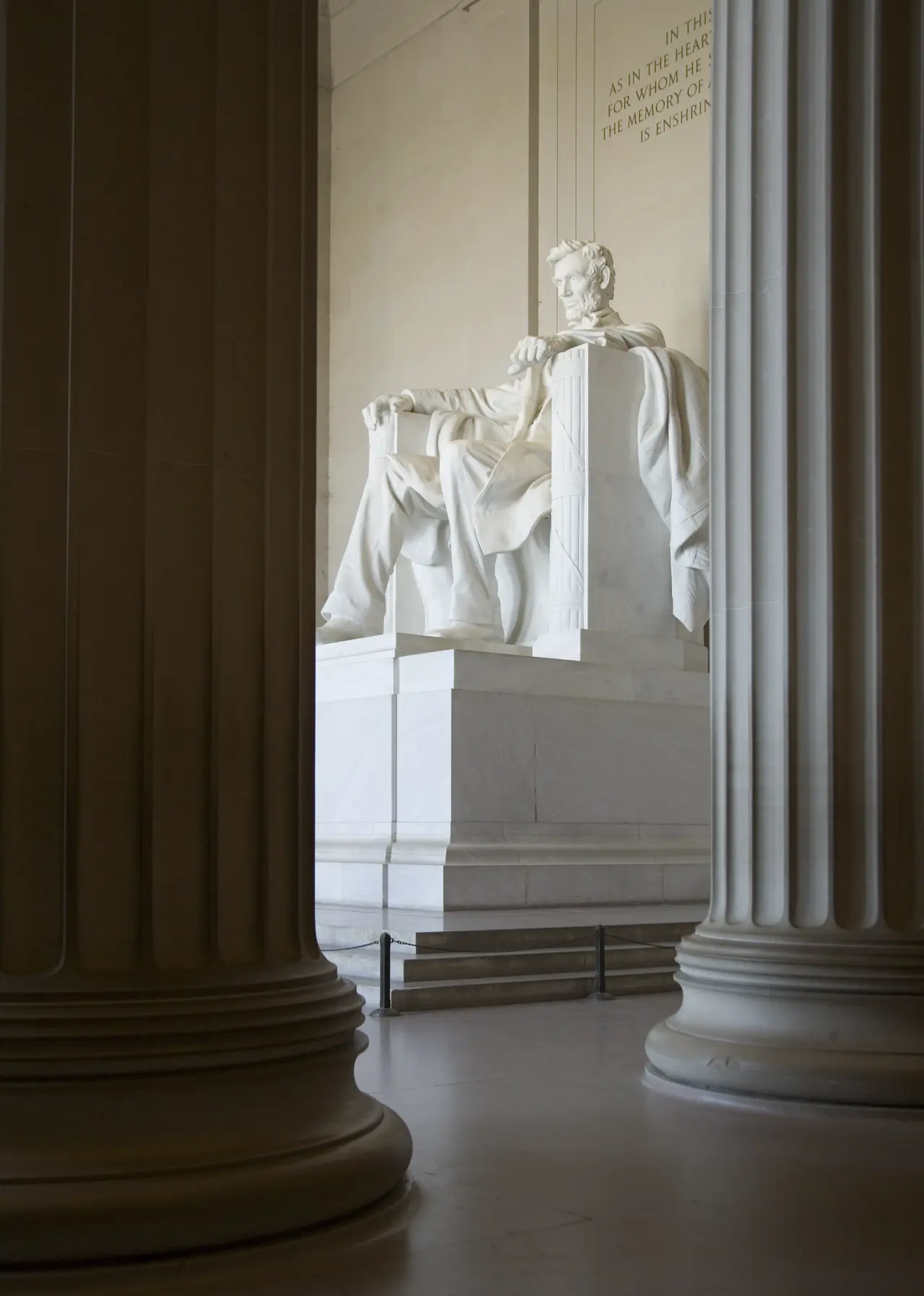
Twenty-eight blocks of Georgia marble
Carol M. Highsmith photographed the statue on May 3, 2006. The Library of Congress record, item 2010630879, reproduction LC-DIG-highsm-04899, says the Lincoln Memorial on the National Mall was dedicated on May 30, 1922. Henry Bacon was the architect. Daniel Chester French sculpted the main statue, Abraham Lincoln, in 1920. Jules Guerin painted the interior murals. The rights line is no known restrictions on publication.
The National Park Service's page on the statue says that under French's supervision the Piccirilli brothers carved it, and that it is 28 separate pieces of Georgia marble, assembled so the joints nearly disappear. The work took four years. French spent years with photographs of Lincoln before he set the hands: one clenched, one more open, with a bundle of rods, the fasces, below them, a sign of strength through unity. The Park Service reads the closed hand as determination to see the war through, and the open hand as the will to take the Southern states back without revenge. It also says he used casts of Lincoln's own hands. An American flag is carved across the chair. The statue was planned at 10 feet and stands 19 feet from head to foot. If the figure rose, the Park Service says, he would be 28 feet tall. The width matches the height, 19 feet. The Georgia marble weighs 175 tons and was shipped in those 28 pieces. It rests on a Tennessee marble pedestal 10 feet high, 16 feet wide, and 17 feet deep. Under that is a Tennessee marble platform 34 feet 5 inches long. The columns of the chamber are a different stone. A park ranger's note on the same page calls them Colorado Yule marble. The statue is the Georgia figure inside.
Before the marble
The tent photograph is a different century of the same man. Library of Congress item 2018666252 is a glass wet-collodion negative by Alexander Gardner, dated October 3, 1862, titled as President Lincoln and General George B. McClellan in the general's tent at Antietam. The summary places it in the main eastern theater, the Battle of Antietam, September–October 1862. The reproduction number is LC-DIG-cwpb-04351. No known restrictions on publication. The catalog on the print says Lincoln met McClellan in that tent two weeks after the bloodiest day in American history. The Library's own date is October 3.
The portrait is earlier still. Item 2011645303 is a platinum print, probably by George B. Ayres, made between about 1890 and 1910 from a negative Alexander Hesler took in Springfield, Illinois, on June 3, 1860, when Lincoln was a presidential candidate. The Library's summary quotes Lloyd Ostendorf's album, which quotes Lincoln's law partner William H. Herndon: "There is the peculiar curve of the lower lip, the lone mole on the right cheek, and a pose of the head so essentially Lincolnian; no other artist has ever caught it." The shop's line for this face gives the office that followed: inaugurated March 4, 1861, and again March 4, 1865, and dead in office on April 15, 1865.
Three prints, three distances. Hesler's candidate in 1860. Gardner's glass plate in a general's tent on October 3, 1862. French's marble, carved for a memorial dedicated on May 30, 1922, and photographed by Highsmith on May 3, 2006. The seated figure is the one to hang large. The other two are the man before anyone carved him.
Shop the story

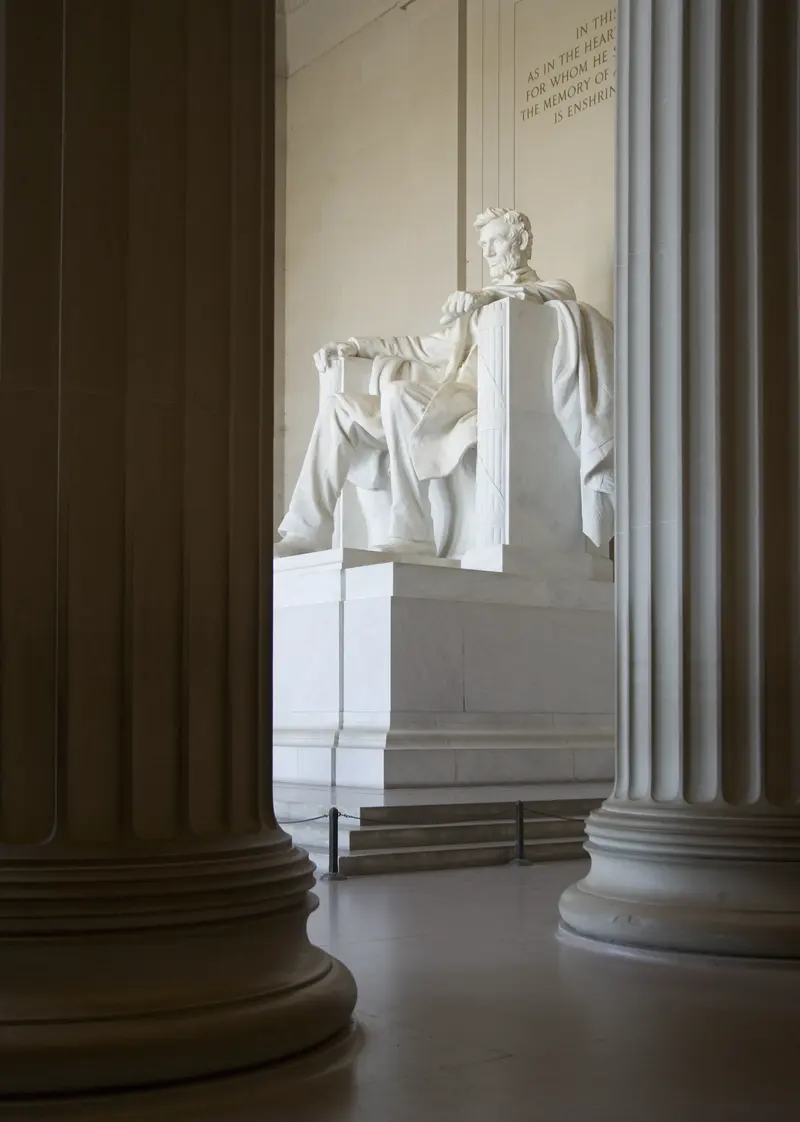
No. 288 · Cast in Bronze & Marble
Lincoln, Seated, Daniel Chester French, 1920
Sculpted by Daniel Chester French. Photographed by Carol M. Highsmith.
From $34

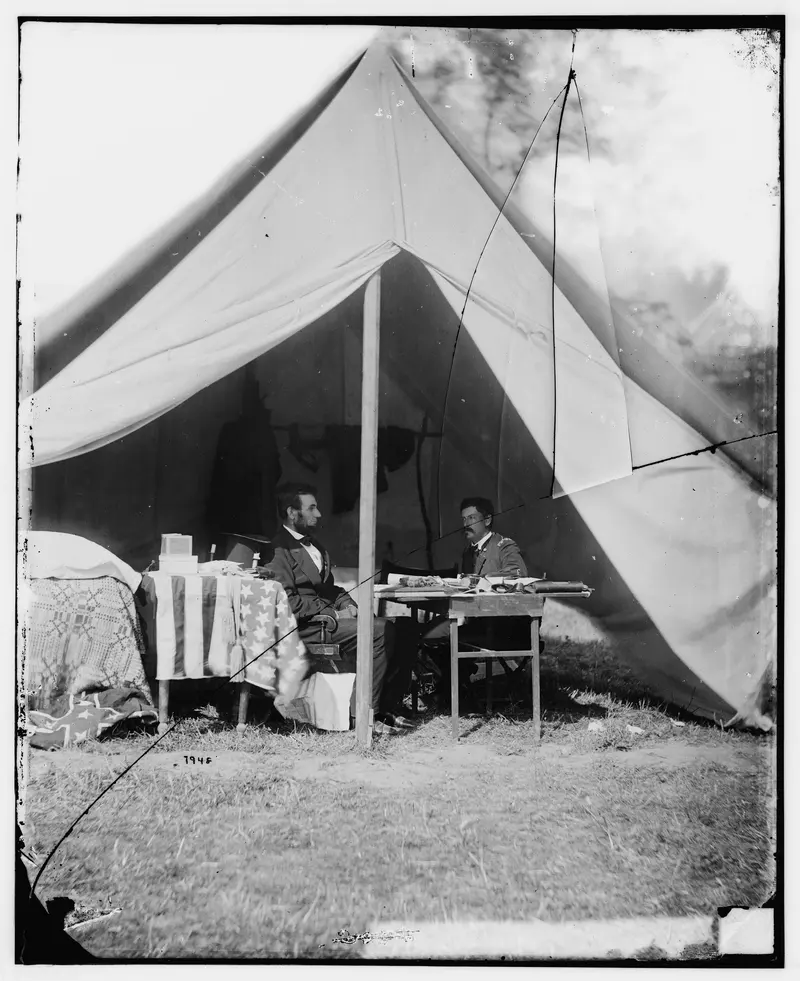
No. 049 · Presidents
Lincoln at Antietam
Source: Library of Congress
From $29
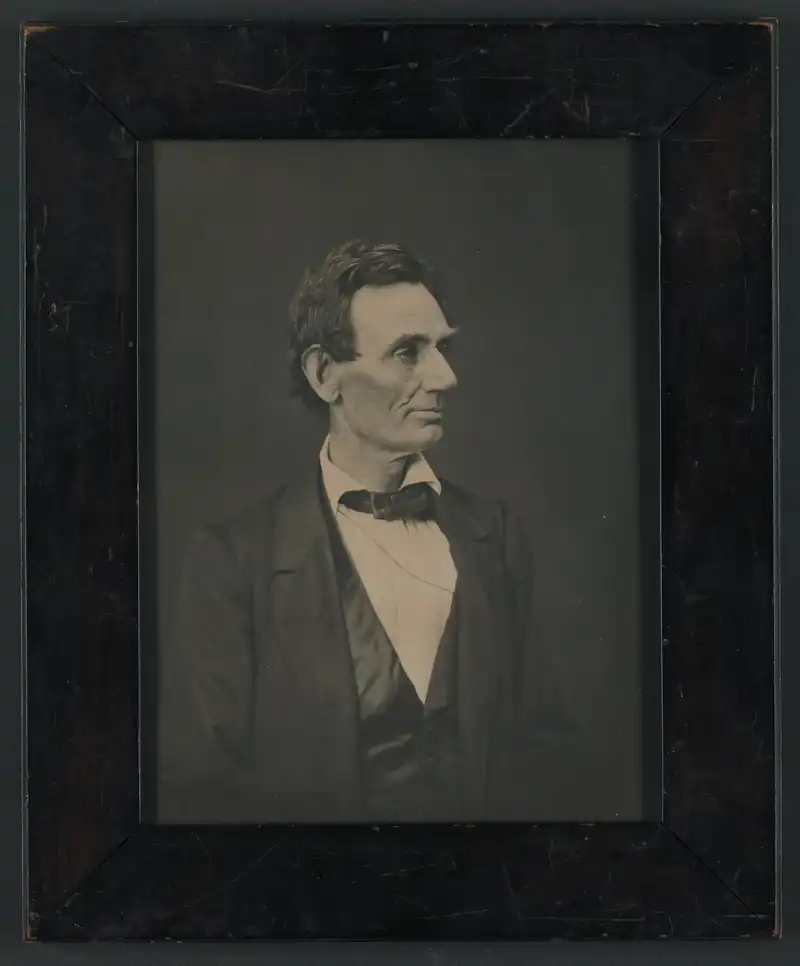
No. 082 · Presidents
Abraham Lincoln
Photographed by Alexander Hesler
From $29
Sources
- Lincoln Memorial statue, Carol M. Highsmith, Library of Congress 2010630879
- Lincoln statue, Lincoln Memorial, National Park Service
- Lincoln and McClellan in the general's tent, Alexander Gardner, Library of Congress 2018666252
- Abraham Lincoln, presidential candidate, Alexander Hesler, Library of Congress 2011645303