A story
A dam in Black Canyon, locks at Gatun
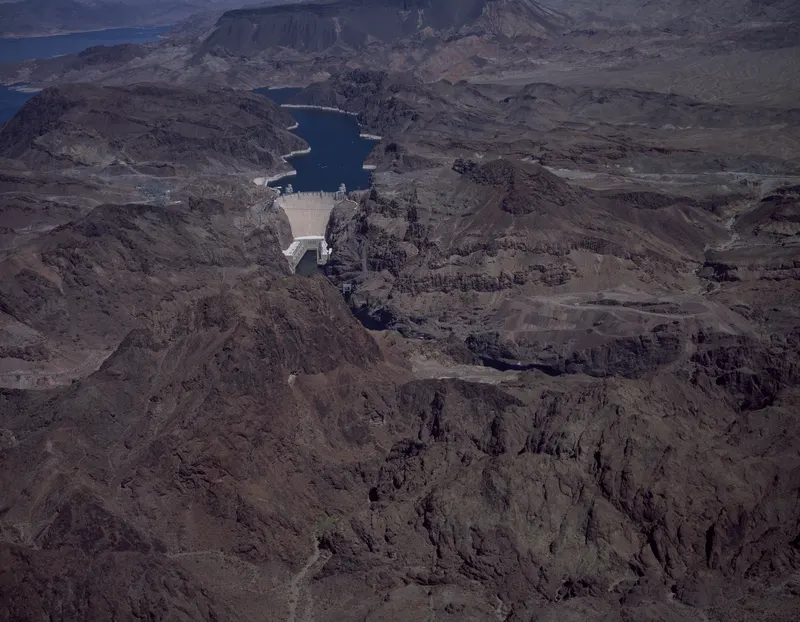
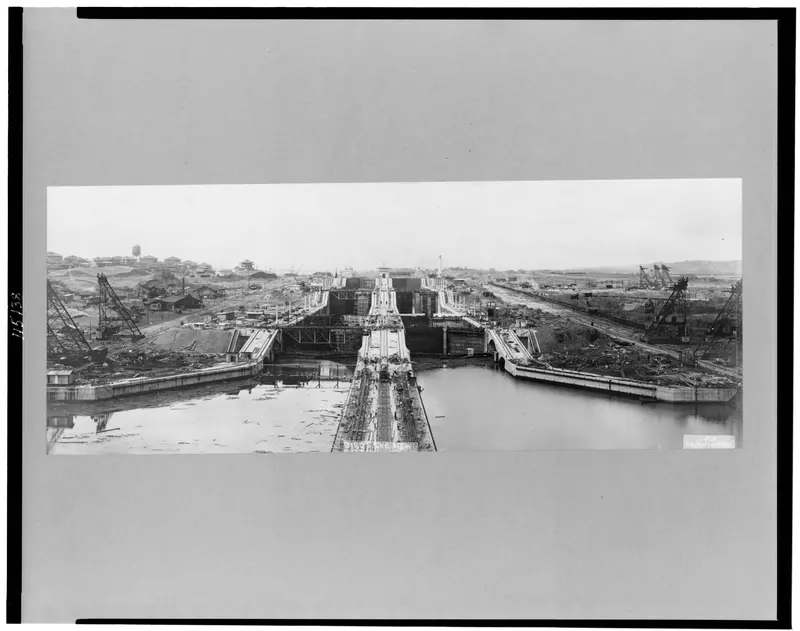
Hoover Dam's last concrete went in on May 29, 1935, inside a seven-year contract that began in April 1931. Carol Highsmith later photographed it from the air. The other print is a 1913 bird's-eye view of the Gatun Locks.
Black Canyon
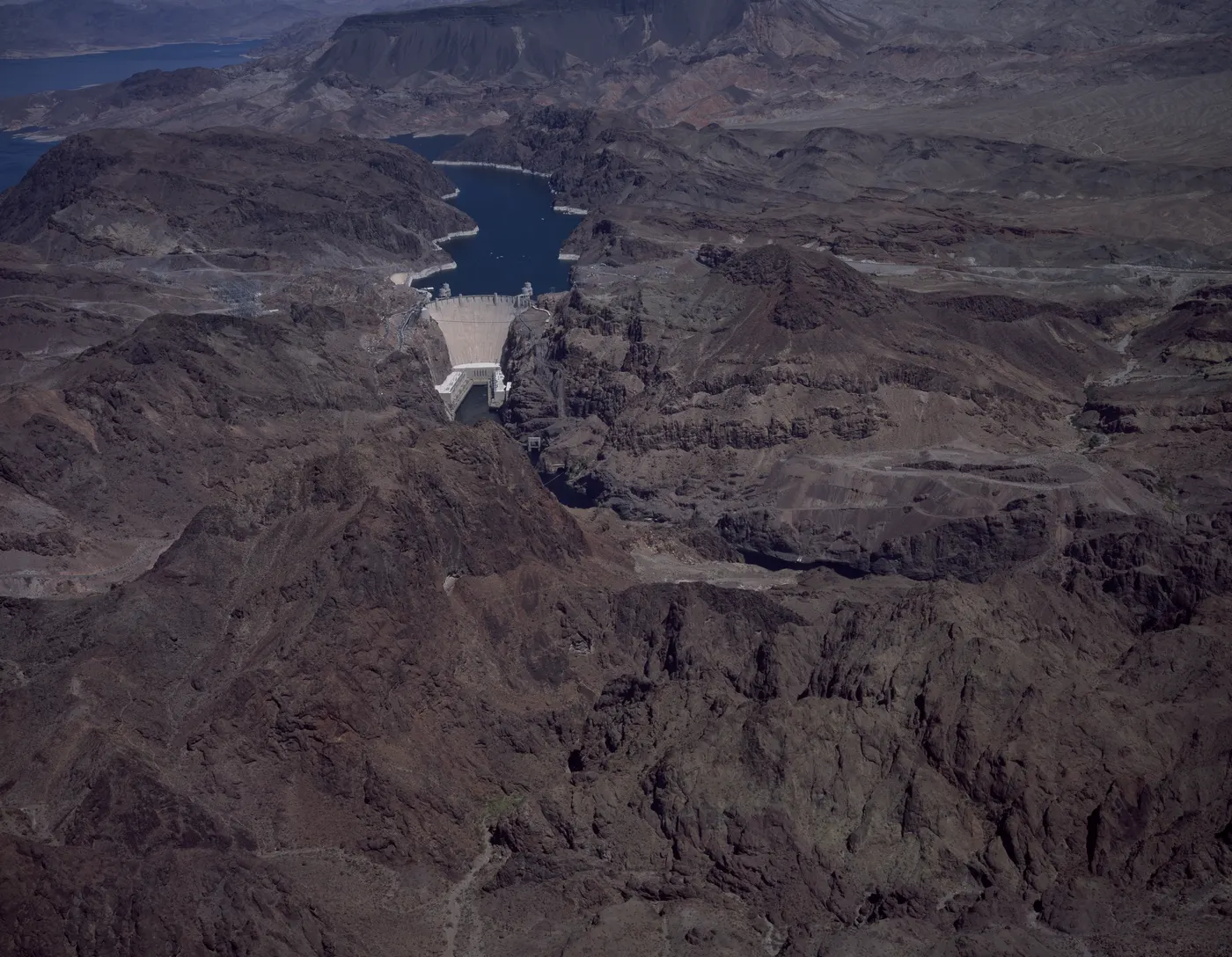
The Bureau of Reclamation's dam FAQ places Hoover Dam in Black Canyon, on the Colorado River between Arizona and Nevada, about 30 miles southeast of Las Vegas. It is a concrete arch-gravity dam, 726.4 feet from foundation rock to the roadway on the crest. The towers and ornaments rise another 40 feet. Reclamation gives the concrete in the dam as three and one-quarter million cubic yards, and 4,360,000 cubic yards if the power plant and the other works are counted. That volume, the bureau says, would pave a standard highway 16 feet wide from San Francisco to New York. The first concrete was placed on June 6, 1933. The last went in on May 29, 1935.
The contract allowed seven years from April 20, 1931. Concrete in the dam was finished on May 29, 1935, and the bureau says all features were done by March 1, 1936, five years in all. A total of 21,000 men worked on it, about 3,500 on an average day, and 5,218 on the busiest day, in June 1934. The average monthly payroll was $500,000. Before that crew could start, Reclamation built Boulder City to house them, seven miles of highway from the town to the canyon, and a railroad in from the Union Pacific at Las Vegas. The concrete itself went in as separate columns, about 215 blocks, because the chemical heat had to be drawn off through more than 582 miles of one-inch pipe circulating ice water. Cooling was finished in March 1935. The photograph in the shop is not a 1935 construction view. Library of Congress item 2011633448 is Carol M. Highsmith's aerial, a color transparency dated between 1980 and 2006, titled as Hoover Dam near Boulder City, Nevada. Reproduction LC-DIG-highsm-15255. No known restrictions on publication. The dam in her frame is the finished wall, lake on one side, river on the other.
Gatun, about 1913
The Panama print is a generation earlier and a different ocean. Library of Congress item 95515719 is a photographic print, about 1913, titled as a bird's-eye view of the Gatun Locks. The subjects are canal construction, locks, and Panama. A copyright-office number, J185375, is on the record. The reproduction number is LC-USZ62-115138. The catalog on the print says this is the year before the first ship crossed from the Atlantic to the Pacific, in August 1914.
Reclamation's short history of the dam calls it a National Historic Landmark and one of the American Society of Civil Engineers' seven modern civil engineering wonders. The same page says it was the largest dam of its time, built in less than five years in a harsh and barren land. The FAQ adds the weight, more than 6,600,000 tons, and the type, a concrete arch-gravity dam, so the water is held by both the mass of the concrete and the curve of the arch. None of that is printed on Highsmith's transparency. It is the bureau's account of the thing she photographed.
The two pictures are the same kind of boast, made with different machines. Gatun is a staircase of locks, photographed while the concrete was still a job. Hoover is a single wall in a canyon, photographed from the air decades after the last bucket. Reclamation's numbers belong on the dam print: 726.4 feet, last concrete May 29, 1935, a highway 16 feet wide from San Francisco to New York. The Library's date belongs on the Gatun print: about 1913, locks, from above. The catalog on that print adds that the first ship crossed in August 1914. Neither institution endorses the shop. The sentences here are the pages.