A story
The Golden Gate going up
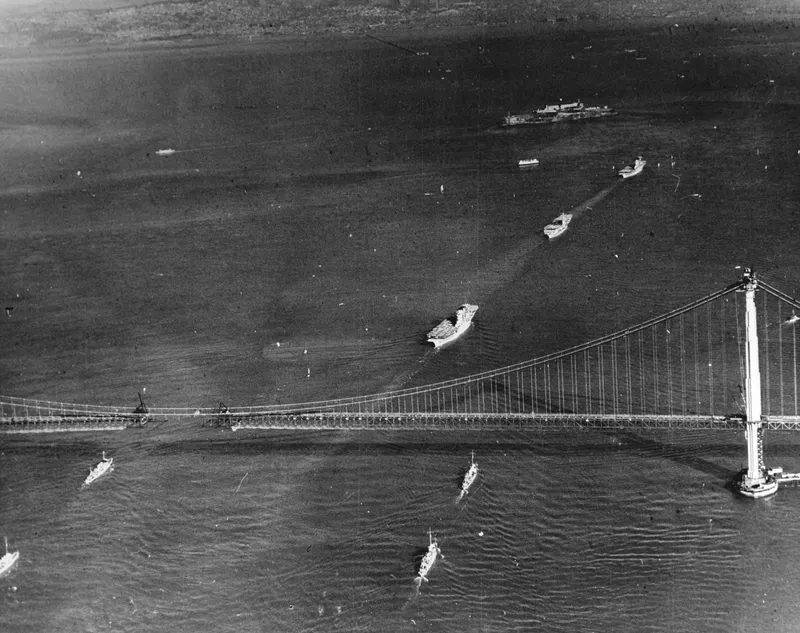
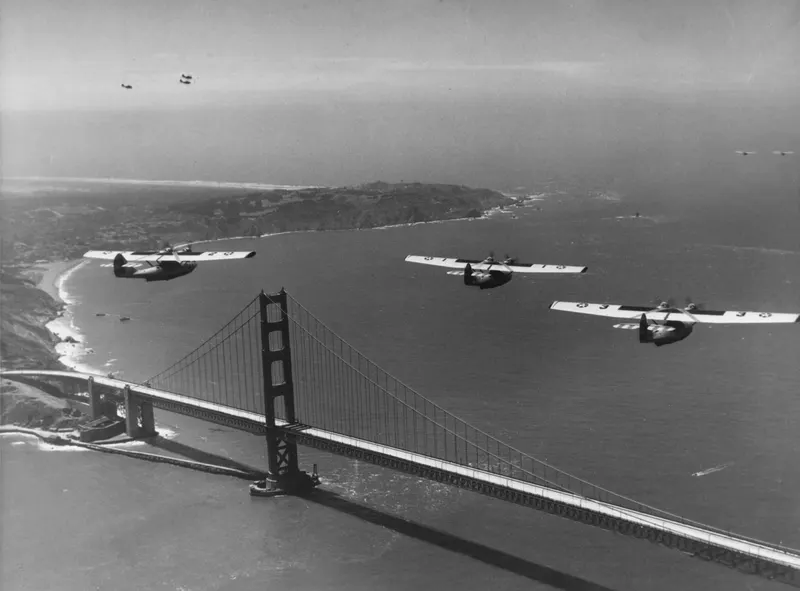
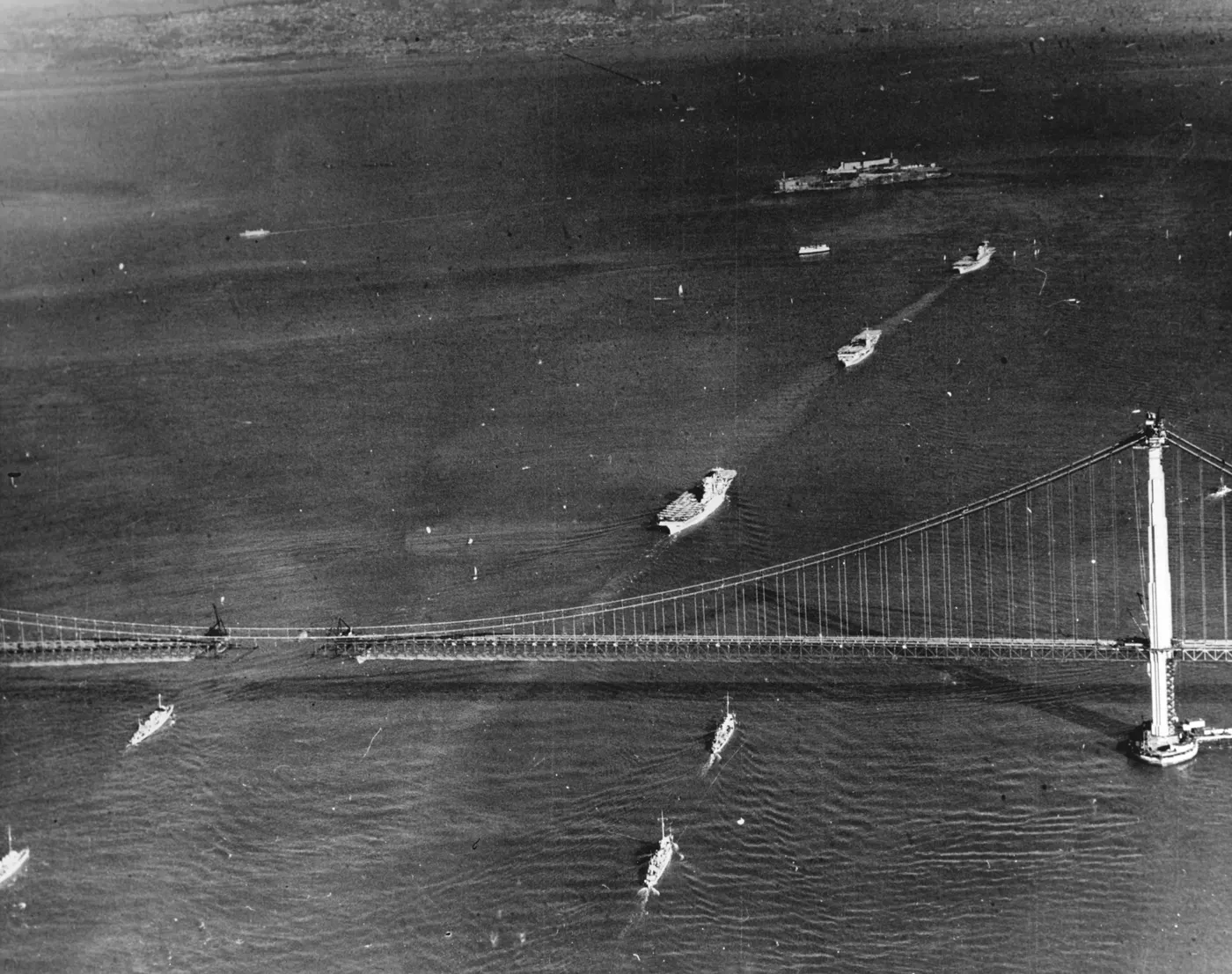
In November 1936 two Navy carriers steamed under the Golden Gate Bridge while the cables were still unfinished. In May 1937, the month the bridge opened, patrol planes flew over the completed span.
A gap with cables in it
Work on the Golden Gate Bridge started on January 5, 1933, Joseph Strauss the chief engineer, a strait that had been a ferry crossing turned into a construction site. By November 1936 the towers were up and the main cables were in place, and the roadway was not finished. That is the month the U.S. Navy sent the aircraft carriers Lexington and Saratoga through the Gate. The photograph shows the two ships under the unfinished span, hulls small against the cables, the deck of each carrier a clean gray shape on the water. The bridge is a drawing that has started to exist.
Lexington and Saratoga were the big carriers of that Navy, converted from battlecruiser hulls after the Washington naval treaty, and in 1936 they were as famous as ships got. Passing under a bridge that could not yet carry a car was a portrait of two kinds of scale. The ships had been the giants. The span was about to be longer, from tower to tower, than any suspension bridge then standing. The photograph holds both facts in one frame, which is why it is the picture to start with.
The month it opened
The bridge opened to pedestrians on May 27, 1937, and to automobiles the next day. It was then the longest suspension span in the world, a title it kept until the Verrazzano-Narrows Bridge opened in 1964. In that same May, Patrol Squadron 9 flew its PBY-1 Catalinas over the new bridge. The photograph is a formation of flying boats, the towers behind them, the roadway finally a line you could imagine driving. A Catalina was a patrol plane, built to stay out over the Pacific for a long time. Using the new bridge as a backdrop was good flying and good publicity, and the Navy kept the negative.
Six months separate the two pictures. In one, the cables are a promise and the ships pass through a gap. In the other, the gap is a bridge and the airplanes treat it as scenery. Hang them in that order, left to right, November then May. You do not need a construction sequence of twelve photographs. Two frames, from the fleet that used the harbor, tell the story of a bridge going from obstacle to landmark.
Strauss's crews worked in a wind that treats the Gate as a funnel. A safety net under the deck saved nineteen men, the group that called itself the Halfway to Hell Club. Eleven workers died on the job, ten of them when a scaffold failed in February 1937 and took the net with it. The November photograph is before that loss. The May photograph is after the opening. Pedestrians crossed on May 27, 1937, and automobiles followed the next morning, while the Catalinas were still using the new span as a backdrop. The roadway was a public street. Strauss's name is the one on the plaques. The steel and the spun wire are the rest of the history, and these pictures are the Navy's view of the result. Both photographs are works of the United States Navy, public domain, the kind of record a service makes when something large happens in its water. The dates are the whole argument. November 1936, unfinished. May 1937, open. The longest span of its moment, with carriers under it and patrol planes over it, because San Francisco's harbor was a Navy town and the bridge had just become part of the sky.