

A story
Flagler's Florida hotels
Henry Flagler built hotels to give his railroad a reason to arrive. Detroit Publishing photographed them in color around 1900: St. Augustine, Palm Beach, Miami, and the harbor at Key West.
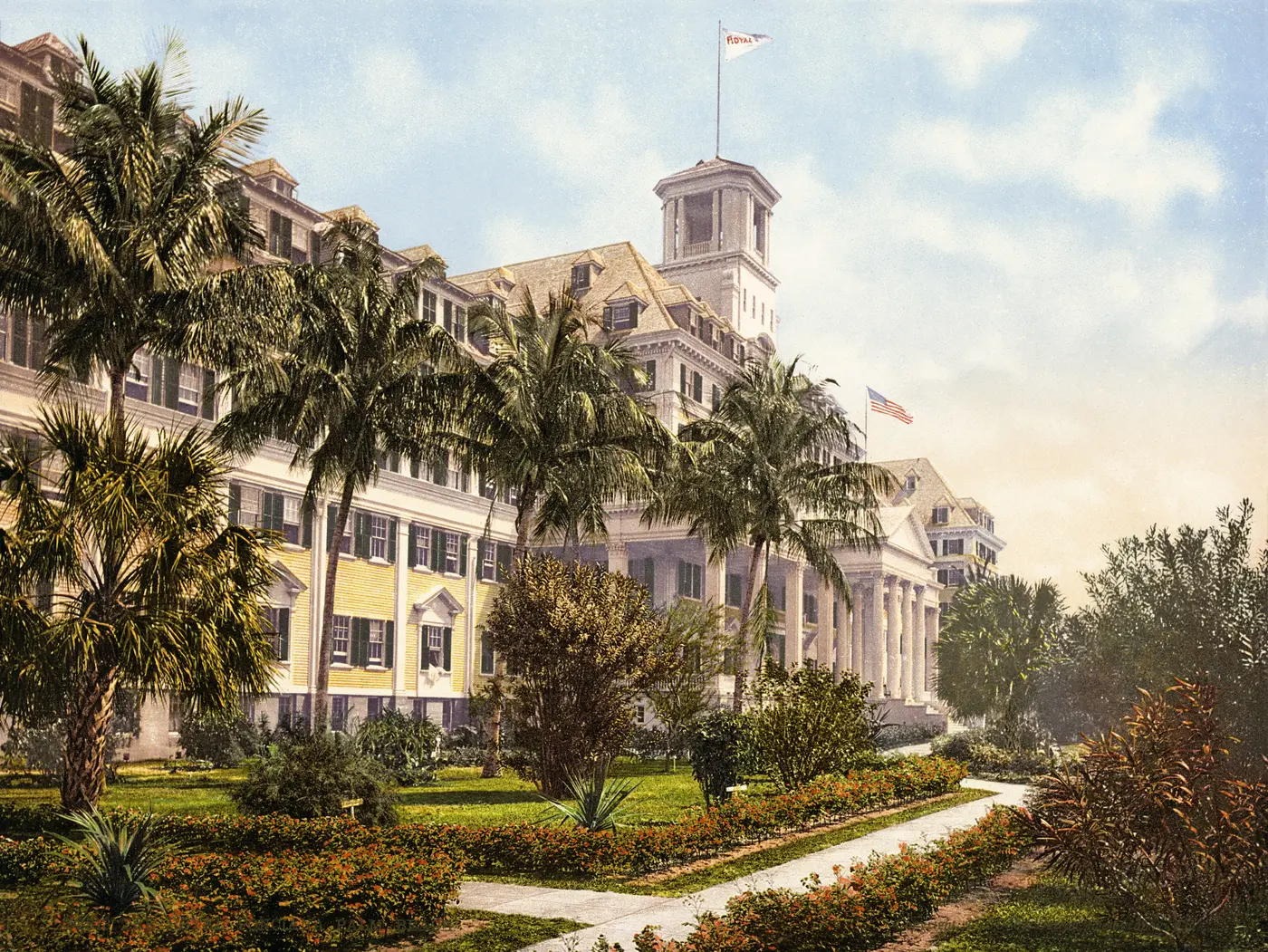
A railroad that needed a ballroom
Henry Flagler, who had made his first fortune with John D. Rockefeller at Standard Oil, decided in the 1880s that Florida's east coast was a winter resort waiting for a track. He bought and rebuilt railroads, pushed them south, and built hotels at the stops so a passenger would have somewhere to dress for dinner. The pictures in this group are Detroit Publishing Company photochroms, color lithographs made from black-and-white negatives, taken around 1900. They are the hotels at the moment the railroad was proud of them.
The freeze of the winter of 1894–95 killed citrus north of Miami and helped convince Flagler to take the line the rest of the way. Julia Tuttle, who owned land on the Miami River, urged the extension. Miami was incorporated on July 28, 1896. The hotels below are the architecture of that decision, from the city he started in to the river he ended at, plus the island his tracks had not reached yet.
St. Augustine, then Palm Beach
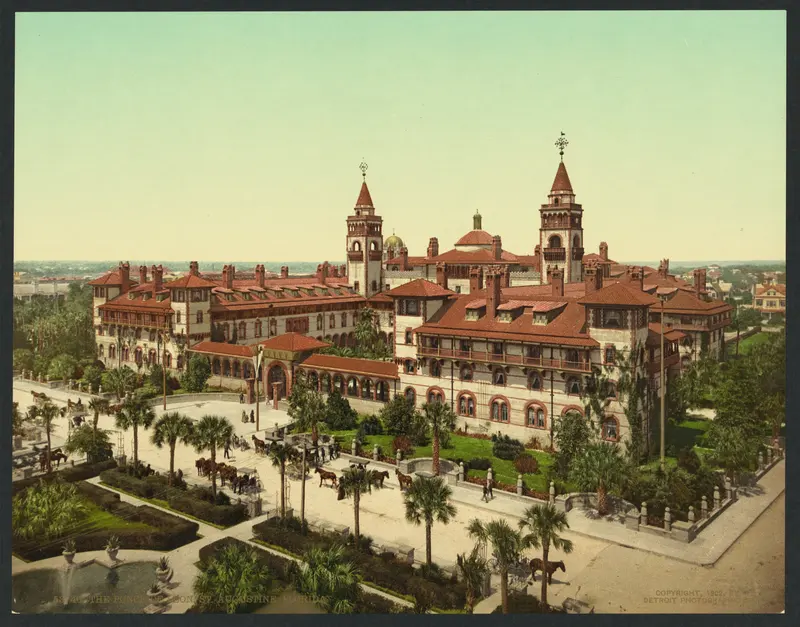
The Ponce de Leon in St. Augustine opened in 1888, Flagler's first great Florida hotel, designed by Carrère and Hastings in a Spanish Renaissance manner in the oldest continuously occupied European city in the country. The photochrom is from about 1902, Library of Congress LCCN 2008679531. Courtyards, towers, a building meant to tell a northern guest that Florida had a history older than the railroad. It later became part of Flagler College. In 1902 it was still a hotel, and Detroit's printer gave the stone a warm color.
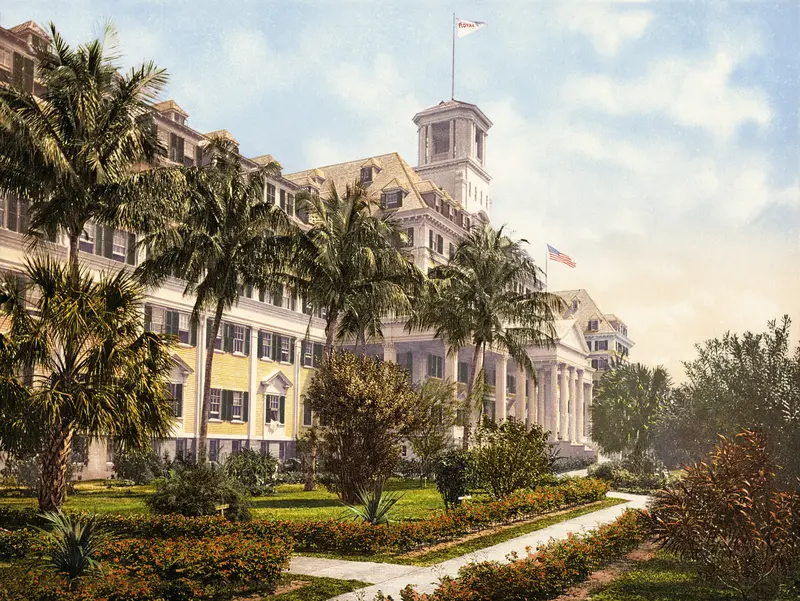
Palm Beach was the next performance. The Royal Poinciana, which opens this story, opened in 1894 and was billed as the largest wooden building in the world, a pale sprawl of verandas between Lake Worth and the ocean. The 1900 photochrom shows the size, which is the point of the picture. Guests came by Flagler's train and then by his little railroad across the lake. The building was the advertisement.
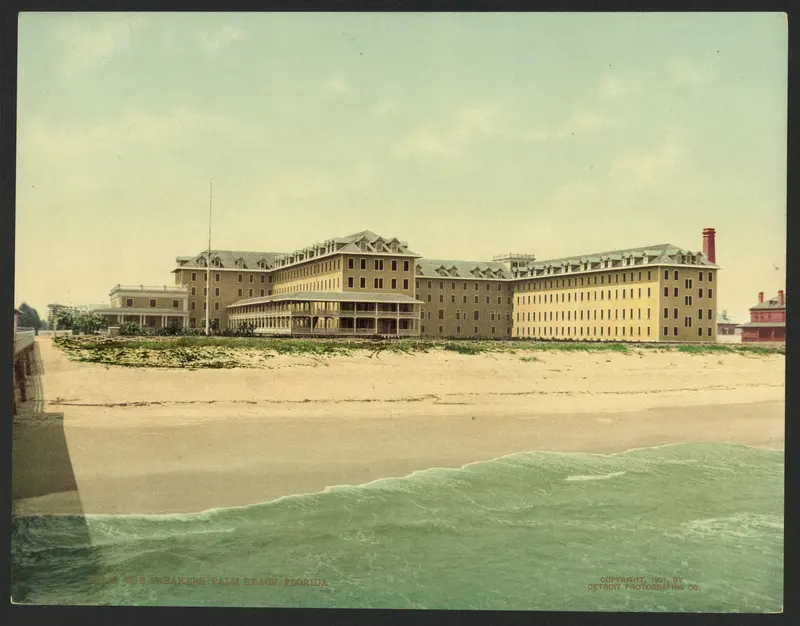
The Breakers, on the ocean side, opened in 1896. The photochrom is 1901, LCCN 2008679530, the original hotel, two years before a fire in 1903 burned it and forced a rebuilding. The print is the first Breakers, not the stone palace that stands there now. That is worth saying on the mat. You are looking at the wooden oceanfront house Flagler was proud of in 1901, lawn, surf, and a roofline Detroit's colorist took care with.
Miami, and a harbor still waiting
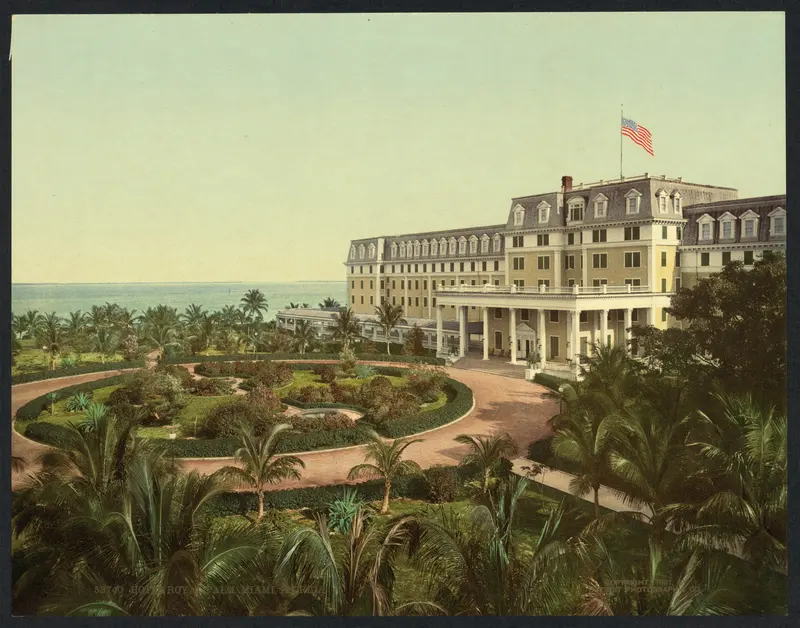
The Royal Palm opened in January 1897 at the mouth of the Miami River, a year after the city incorporated. The 1901 photochrom, LCCN 2008679529, puts the hotel on the river with Biscayne Bay beyond. This is the building that made the new city look finished. Flagler had his railroad, his hotel, and a town named by the river. The photograph is how a winter visitor would have described Miami in a letter: large, new, and surrounded by water.
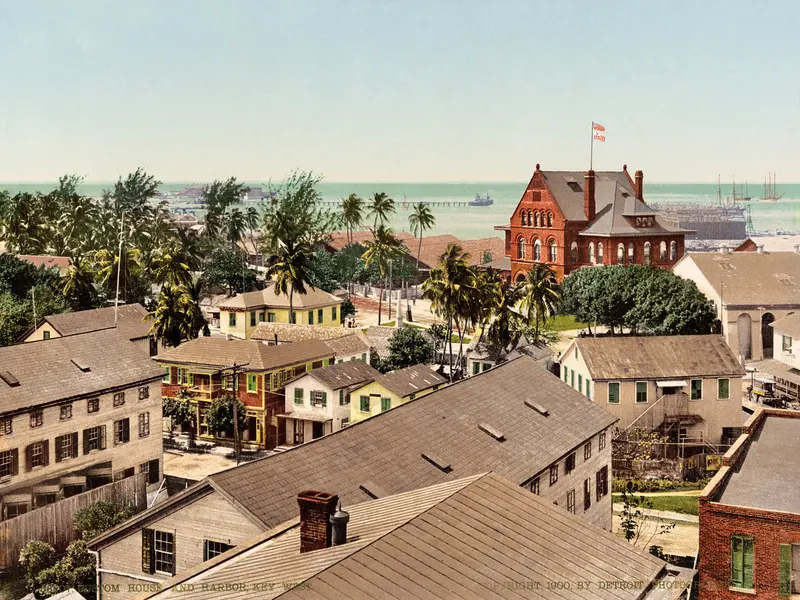
Key West, in the 1900 photochrom, is the Custom House and the harbor of the southernmost city, a working port with a long Spanish and Bahamian history of its own. Flagler's Overseas Railroad would not reach the island until January 22, 1912. The picture is the before. Ships did the work the train had not started. Hang it at the end of the row and the eye travels the way the tracks did, from St. Augustine down through Palm Beach and Miami, and then stops at a harbor that is still itself.
Five photochroms, one builder, and a process that was made for postcards and parlors. Detroit Publishing licensed the Swiss photochrom method and used it on exactly the subjects a railroad wanted colored: hotels, harbors, civic pride. The Library of Congress files carry the plate numbers. The dates are about 1900 to 1902. The fire at the Breakers is 1903, so that print is a building with a short life left. The Royal Poinciana's claim to be the largest wooden hotel is the claim the age made, and the photograph is big enough to let you test it with your eyes.
Shop the story

No. 058 · Your City
Palm Beach, 1900: The Royal Poinciana
Photographed by Detroit Publishing Company
From $29
No. 057 · Your City
Palm Beach, 1901
Photographed by Detroit Publishing Company
From $29
No. 059 · Your City
Miami, 1901: The Royal Palm
Photographed by Detroit Publishing Company
From $29
No. 060 · Your City
St. Augustine, 1902: The Ponce de Leon
Photographed by Detroit Publishing Company
From $29
No. 061 · Your City
Key West, 1900
Photographed by Detroit Publishing Company
From $29
Sources
- The Royal Poinciana, Palm Beach, about 1900, Detroit Publishing Company
- The Breakers, Palm Beach, about 1901, Library of Congress LCCN 2008679530
- Hotel Royal Palm, Miami, about 1901, Library of Congress LCCN 2008679529
- The Ponce de Leon, St. Augustine, about 1902, Library of Congress LCCN 2008679531
- Custom House and harbor, Key West, about 1900, Detroit Publishing Company

