A story
Diana on the Garden tower
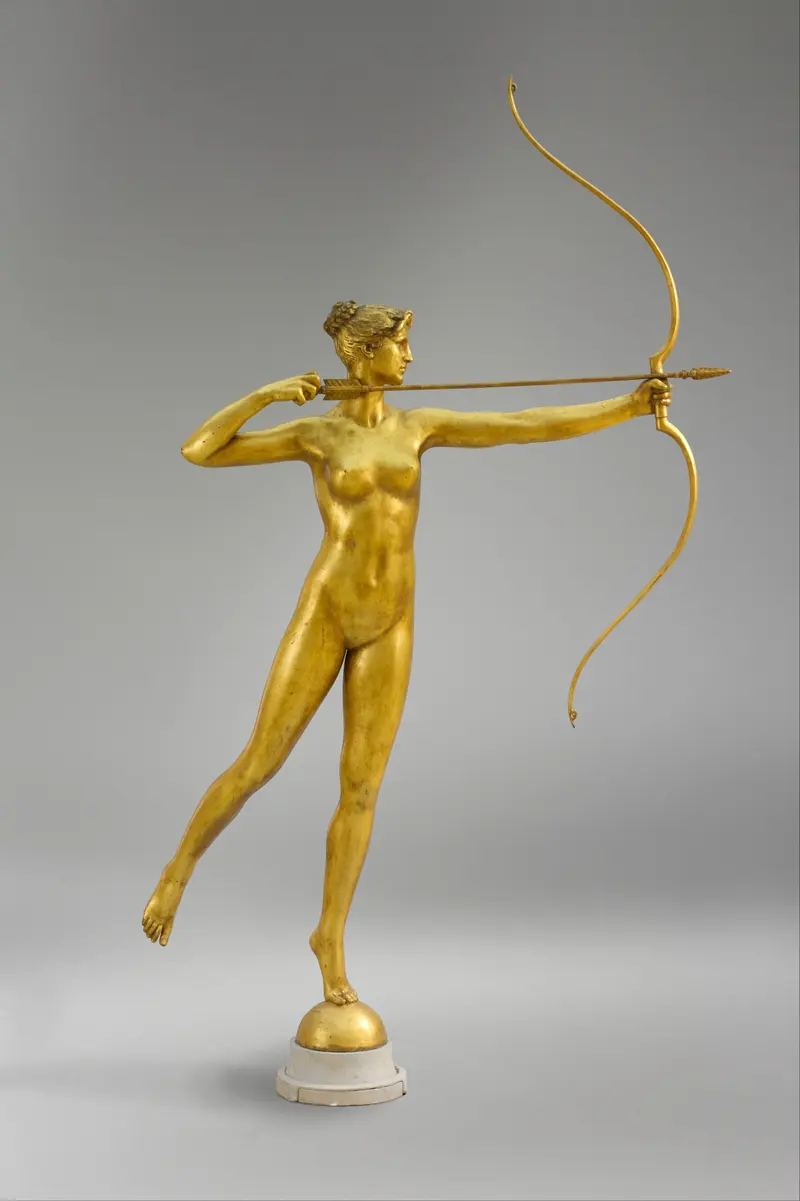
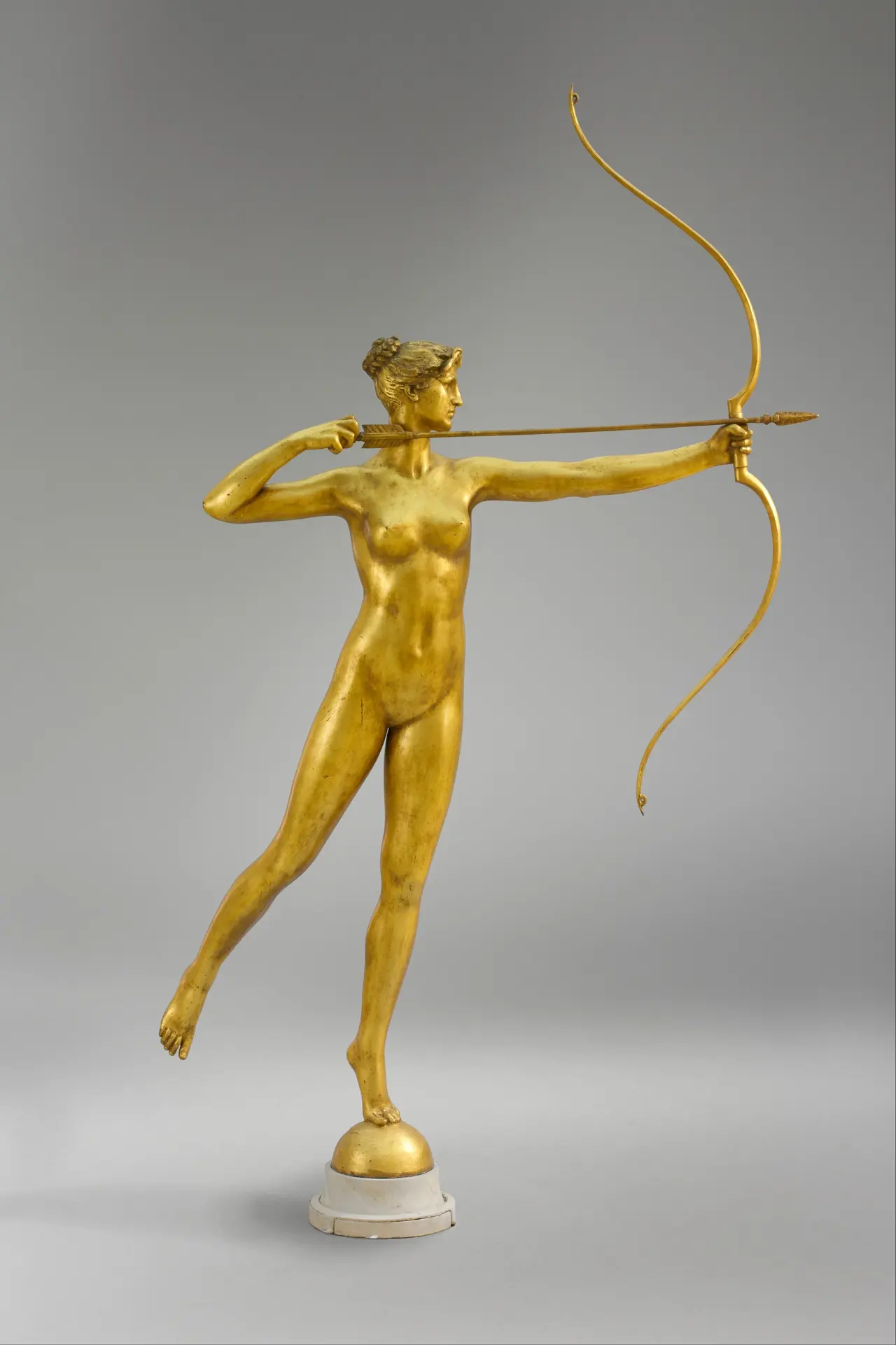
Augustus Saint-Gaudens modeled Diana in 1892–93. A gilded version turned as a weathervane on Madison Square Garden until the building came down in 1925. The gilt bronze in the shop is the Metropolitan Museum's 1928 cast.
A weathervane over the city
The National Park Service's account of the model Davida Johnson Clark says Saint-Gaudens modeled the face of his famous Diana after her. The same page says the statue was installed as a weathervane on top of the tower of Madison Square Garden in New York City, and that it stayed an iconic fixture of the skyline until the building was demolished in 1925. By day the gilded figure could be seen from all over the city. It could also be seen at night, the Park Service writes, because it was one of the first statues in the city to be electrified.
Saint-Gaudens National Historical Park's visitor text captions a photograph "Diana, second version, 1892" and credits the Metropolitan Museum of Art. The description with that image is a bronze figure standing on one leg, pulling a bow and arrow. That is the subject. The tower figure and the museum cast are not the same object. The Garden came down in 1925. The bronze in this shop was cast three years later.
The cast in the American Wing
The Metropolitan Museum of Art's Open Access record for object 11998 is public domain. The title is Diana. The artist line is Augustus Saint-Gaudens, American, Dublin 1848–1907 Cornish, New Hampshire. The object date is 1892–93, cast 1928. The medium is bronze, gilt. The dimensions are 101 3/4 by 53 1/2 by 14 1/8 inches. The accession number is 28.101, Rogers Fund, 1928, in The American Wing, gallery 700. The museum names the founder as Preissmann Bauer & Co. The tags on the record are a bow and arrow, and Diana.
The Park Service's life of the sculptor, which matches the dates on that label, says he was born in Dublin on March 1, 1848, to Mary McGuiness and Bernard Saint-Gaudens, a French shoemaker, and that the family immigrated to New York six months later. He apprenticed as a cameo cutter from the age of 13, studied at the École des Beaux-Arts, spent five years in Rome, and returned to the United States in 1875. His first major public commission, a monument to Admiral David Glasgow Farragut, was unveiled in Manhattan in 1881. Over the next 25 years he completed more than 150 works. He taught at the Art Students League from 1888, and the park's older guide says the teaching ran through 1897. He advised the World's Columbian Exposition of 1893. After a cancer diagnosis in 1900 he lived year-round at the Cornish place he called Aspet, and he died there on August 3, 1907. The same guide says he worked with architects, Stanford White among them, so that a sculpture and its setting were designed together. Diana's setting was a tower. The setting is gone. The 1928 cast is what the museum kept.
Hang the print as the museum's cast, not as a photograph of the lost tower. The record gives the model years, the foundry, the gilt surface, and the height. It also lists a second measurement, taken in 2014, for the bronze as it is displayed: about 516 centimeters overall, taller than the sculpture alone because of the mounting. The object itself remains 101 3/4 inches. The Park Service gives the reason the figure is famous: it once turned in the wind above Madison Square Garden, bright enough to read against the sky by day and lit after dark. The shop's photograph is of the bronze the Met still owns.